
Blessed is the Nation Whose God is the Lord
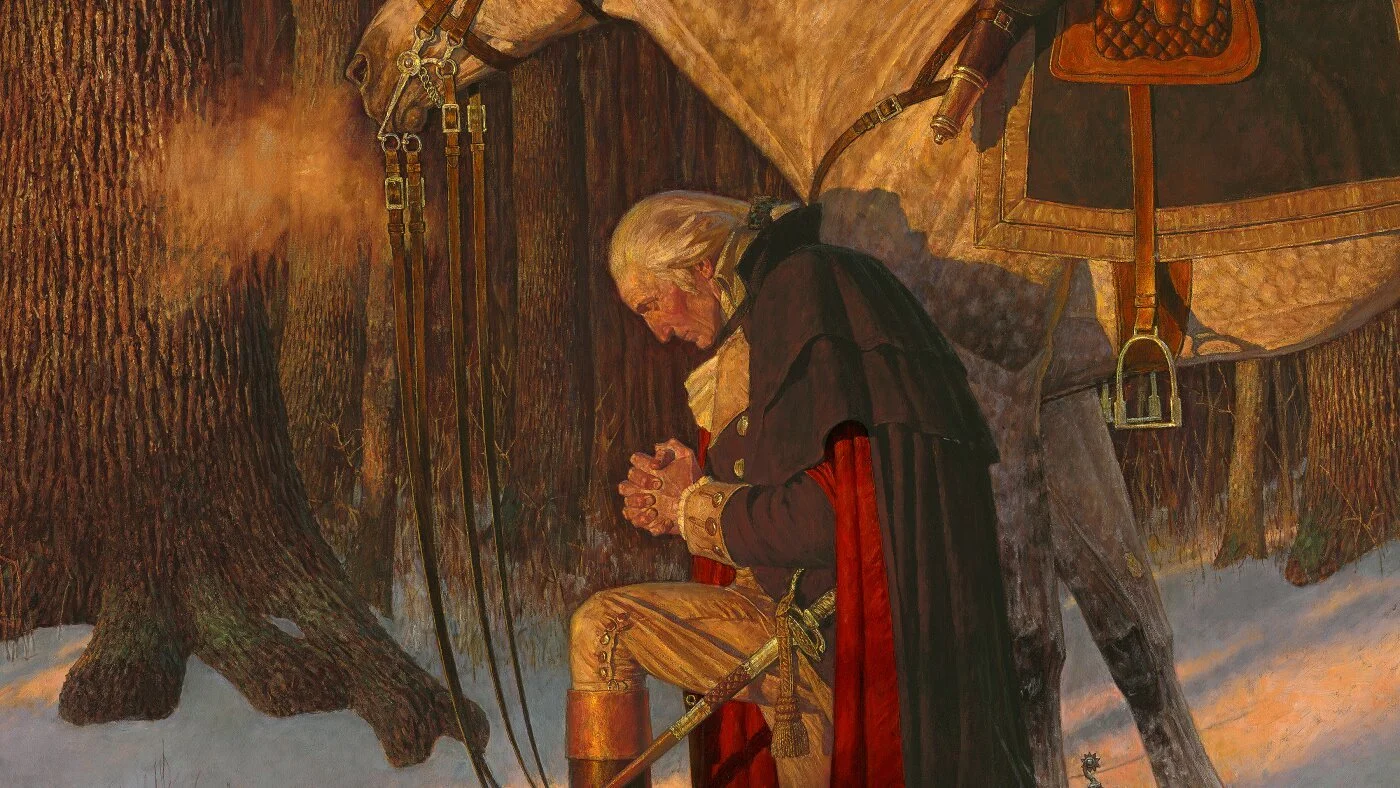
Blessed is the nation whose God is the LORD, the people whom he has chosen as his heritage!
Psalm 33:12
The Psalms abound with declarations of blessings from God to man. We expect these to always be to the individual: “Blessed is the man” (אַשְׁרֵי הָאִישׁ) in the first words of the book. We also might tend to restrict such verbal blessings to the formal “benediction,” perhaps as words that wish some good for someone else. Those blessings declared in God’s word must be more than well-wishing, but must be a divine determination. The sense of this blessing in Psalm 33:12 is an instance where blessing is fixed to some human action or state of affairs, so that the good that comes upon its recipient is a moral consequence of sorts. That brings up another difficulty for those who have been taught to emphasize God’s sovereignty (to bless in this case) at the expense of secondary causes (especially moral duty that is fixed to blessings and curses).
Here, though, we get the sense of a more persistent and detailed objection.
Objection: “You cannot use this passage to apply to any other nation than the Old Testament nation of Israel because the second line in the parallelism says the people whom he has chosen as his heritage. That defines the nation as the chosen seed, namely, of Abraham. New Covenant Christians may only apply this to our lives as that spiritual nation that Peter talks about.”
Reply: There are three basic reasons why this is false.
First, the context of the whole Psalm relates God’s sovereignty and power to His people in the whole of life: including in the corporate life of the nation. Therefore, an exclusively spiritual application to the church is an unnatural reading.
Second, the Psalmist frames the statement in the universal affirmative—‘the nation’—meaning, “All nations for whom God is the Lord are blessed nations”; or “Any nation for whom God is the Lord is a blessed nation.”
Third, contrary to Anabaptist, pietist, and modern liberal theologies, no serious Christian theologian or tradition would have ever believed that a nation cannot be Christianized, at least to the point where its civic leadership ruled in the name of Christ. Matthew Henry attaches to the application to Israel, matter of factly, “and all others who own God for theirs and are owned by him; for they also, whatever nation they are of, are of the spiritual seed of Abraham.”1
The very language of Genesis 12 can be argued to support the blessing of Christian nations, since “in you all the families of the earth shall be blessed” (v. 3) does not require that these families cease to be families just because the spiritual seed is passed on individually by regeneration and faith. Presbyterians of all Christians ought to spot the either-or fallacy that pits the necessity of faith to the spiritual inheritance against God continuing to work through families. If this is true of families, then the fallacy remains a fallacy when it is extrapolated to the level of larger people groups. At any rate, three times after in Genesis this seed is still described not merely from out of the nation, but as nations (cf. 18:18; 22:18; 26:4).
All of that to say that this is one of those truths of nature taught by the light of Scripture. And what specifically is that truth?
Doctrine. To the degree that any nation is under God’s law, they have God’s blessing.
The blessing of a nation with God as Lord.
The evidence of a nation with God as Lord.
The ways of a nation having God as Lord.
The blessing of a nation with God as Lord
Such a nation would be blessed in at least five ways:
First, it is blessing to have triumphed by God’s decree. Note the contrast of this verse with the two preceding verses:
The LORD brings the counsel of the nations to nothing; he frustrates the plans of the peoples. The counsel of the LORD stands forever, the plans of his heart to all generations (vv. 10-11).
In other words, the nation whose God is the Lord has come out of a victory that God has won over the other nations. They counseled together, a conspiracy against Christ, so says Psalm 2:1-3. Hence that divine counsel that brought God’s favored nation out of conflicts with those nations He defeats, are blessed by such a deliverance.
Second, it is blessing to be God’s property: “But the LORD’s portion is his people” (Deut. 32:9). As the name LORD in our passage implies His ownership of us. If Christians are God’s prized possession, as Peter translates Moses words to Israel in Exodus 19:6, in his first epistle (2:9), then it follows that a whole nation of such is no less God’s property.
Third, it is blessing to be enlightened with God’s wisdom. About God’s laws, it says, “Keep them and do them, for that will be your wisdom” (Deut. 4:6). To have wisdom is to know how to live, whereas to not know how to live is to be a fool. Such a contrast makes having to argue for the blessing of wisdom, if not itself foolish, at least superfluous. And yet this is promised to nations and not merely individuals. Solomon asked for wisdom to govern God’s people, and it was given (1 Kings 3:9-12). What if there was a whole nation of Solomons? Even several hundred to make a godly elite would be a blessing.
Fourth, it is blessing to rest in God’s provision: “The eyes of all look to you, and you give them their food in due season” (Ps. 145:15). We take food for granted because we have always known plenty; but that plenty came from God.
Fifth, it is blessing to experience God’s protection: “He makes peace in your borders” (Ps. 147:14). Without the restraining influence of God, the worst of all sinners would far outweigh the best in mankind. Whatever those “greater angels of our natures” that Lincoln talked about, even on their best day, are outnumbered. Indeed, as Yeats knew and set to poetry,
Things fall apart; the centre cannot hold;
Mere anarchy is loosed upon the world,
The blood-dimmed tide is loosed, and everywhere
The ceremony of innocence is drowned;
The best lack all conviction, while the worst
Are full of passionate intensity.
The world is a far more dangerous place than the past few generations of Americans have known, and so we take safety for granted too. The city of God is constantly surrounded by vultures of spirit and flesh, of those “who eat up my people as they eat bread” (Ps. 14:4). If we know nothing of war and bloodshed, then we will have little appreciation for the hand that stays it.
So it is that those things which are the most basic blessings are lightly esteemed.
The evidence of a nation with God as Lord
“But,” you might say, “people knew that God was with Israel because ‘the LORD went before them by day in a pillar of cloud to lead them along the way, and by night in a pillar of fire to give them light’ (Ex. 13:21). There is no such proof today.”
That is true—but we need no such proof, only common evidences that, together, give us sufficient reason to be able to tell that a nation has God as its Lord. Let me mention just six. All of these are evidences in Scripture itself; and if God communicates such evidences in Scripture alongside of miracles, then perhaps He ranks these attributes of a nation higher than we do.
First, the order that comes from righteous laws is clear evidence that a nation has God as Lord. Recall the passage from Deuteronomy 4, which, in full, says,
Keep them and do them, for that will be your wisdom and your understanding in the sight of the peoples, who, when they hear all these statutes, will say, ‘Surely this great nation is a wise and understanding people’ (Deut. 4:6).
It is more than principle; it is also prophecy, as Isaiah speaks of a day when many Gentiles will rouse themselves, “Come, let us go up to the mountain of the LORD, to the house of the God of Jacob, that he may teach us his ways and that we may walk in his paths” (Isa. 2:3). This is specifically to pattern themselves after God’s law. It may be objected that the majority of people would never see this as wisdom. One can craft that objection in any direction and what it amounts to suppose that God is mistaken or lying. This is a true principle that depends not on the majority: “Let God be true though every one were a liar” (Rom. 3:4).
Second, the endurance of a nation is clear evidence that a nation has God as Lord. John Witherspoon was an early president of the College at Princeton, a Presbyterian, and a signer of the Declaration of Independence. He said that,
Civil liberty cannot be long preserved without virtue. A monarchy may subsist for ages, and be better or worse under a good or bad prince; but a republic once equally poised, must either preserve its virtue or lose its liberty, and by some tumultuous revolution, either return to its first principles, or assume a more unhappy form.2
An enduring nation means an enduring people. The nation is its people, so that if they die out or are replaced by another, that nation is cursed. So in the curses section of Deuteronomy 28, we read:
Your sons and your daughters shall be given to another people, while your eyes look on and fail with longing for them all day long, but you shall be helpless. A nation that you have not known shall eat up the fruit of your ground and of all your labors, and you shall be only oppressed and crushed continually, so that you are driven mad by the sights that your eyes see … The sojourner who is among you shall rise higher and higher above you, and you shall come down lower and lower. He shall lend to you, and you shall not lend to him. He shall be the head, and you shall be the tail (vv. 32-34, 43-44).
A people that has been replaced by another is not a nation that has endured. History teaches even the most simple that foreign people do not enter a land en masse except as anything other than an act of war. A people that are suddenly outnumbered are occupied, and that by the deliberation of kings or merchants. A sojourner to whom God commands our care is an individual or a family—they are a friendly guest if indeed they are passing through with humble deference to the local customs. The Scriptures do not confuse barbarian hordes with the weak and weary traveler. A people who allow themselves to be so confused are a people choosing to die.
Third, the just cause when it goes to war is clear evidence that a nation has God as Lord. One of Christ’s prerogatives as “the ruler of kings on earth” (Rev. 1:5) is that, “He shall judge between the nations” (Isa. 2:4). Magistrates are commanded by God, “Rescue the weak and the needy; deliver them from the hand of the wicked” (Ps. 82:4). A people may be subject to propaganda, but history will soon render its verdict. When the dust is clear, it is evident whether magistrates and generals have sought riches or empire at the price of blood.
Fourth, the care it takes of its weakest is clear evidence that a nation has God as Lord. If Jesus can say, “Truly, I say to you, as you did it to one of the least of these my brothers, you did it to me” (Mat. 25:40), and if this is a sign of one’s faith being genuine, then this same virtue must be prominent in a society that claims the name of Christ. Conversely, “Whoever mocks the poor insults his Maker” (Prov. 17:5). It is true that many are in poverty by a slack hand, and, in the modern world, by the incentive of the welfare state. But it is also true that many have been become destitute by war or famine, or by losing one’s parents, or simply by an elite class that has marginalized certain groups and even a whole generation from markets and industry and educational opportunities.
Fifth, the innovation and wealth overflowing to friendly nations is clear evidence that a nation has God as Lord. Laban said to Jacob, “I have learned by divination that the LORD has blessed me because of you” (Gen. 30:27). If Laban were not blinded by his own evil plots, this would have required no “divination.” Everywhere the patriarchs went, everyone who took them in benefited. So it has been ever since, as all of the cultural and material blessings enjoyed by modern man were the product of the Christian nations of the West.
Sixth, the number and longevity of Christian nations over the past two millennia is clear evidence that a nation has God as Lord. We have been inundated over the past few generations with the alleged evils of Christendom—the chief evil that there is such a thing as Christendom to begin with! However, ever since the legalization of Christianity in 312 by Constantine, many nations (however imperfect) have provided those “Kings [who] shall be your foster fathers, and their queens your nursing mothers” (Isa. 49:23). And all of the most physically terrifying evils have been either put away or contained. As Christendom, recedes, they reemerge.
Honest people can look at these things. They can tell when a war has been genuinely defensive and when it has been driven by greed or pride. They can tell when there is compassion and courage among a people, or whether the nation is peopled by cowards and the callous. God’s people are called a light precisely as a nation (Isa. 2:5), such as a lighthouse provides safe harbor to those who have been long at sea. And this is a blessing from God that will commend itself to others. So, after seeing the blessing of a nation with God as Lord, and the evidence of a nation with God as Lord, we may now see the ways or paths or means by which such blessing is attained.
The ways of a nation having God as Lord
Nations are moral entities. If individual persons are moral beings, then a group of persons have transferred a portion of each individual person’s moral action. Moral entities are under God’s moral law. That starts with the Ten Commandments. The division into two tables shows us the two most basic “ways” of a nation having God as Lord.
A nation’s religion is the primary way of having God as Lord. The first table of the law (commandments 1 through 4) regard religion. Religion just means rightly ordered worship—worship of the true God. A nation has no claim on God as Lord if they do not care about the most basic elements of worship—whether it is the true God they worship, whether graven images are bowed down to instead, whether His name is dishonored in the streets, or whether we cannot afford to devote one day in seven to focus our all on Him. Modern liberalism says that one religion is as good as another when it comes to civic life, but God says to His people in the Bible, that,
he who fails to find me injures himself; all who hate me love death (Prov. 8:36).
You will either have the one true God in your public religion, or you will die the most horrible death, because the death that comes in the end of a nation is the most horrible form of death.
A nation’s ethics are the secondary way of having God as Lord. Another natural law way that the Scriptures say this are in these words: “Righteousness exalts a nation, but sin condemns any people” (Prov. 14:35). Do you hear that? This is the way of any people, it says. The second table of the law (commandments 5 through 10) regard right behavior toward one another. This respects the image of God, in the form of human authority, life, marriage, property, our good name, and our contentment with our specific lot that God has assigned. God makes His blessing on a nation hinge upon how we either uphold the image of God in these six ways, or else we will be cursed by committing or permitting violence against the image of God in these six ways.3
So the first WAY is a nation’s true religion, the second WAY is that nation’s treatment of each other.
A third way that a nation has God as its Lord is that A nation’s leaders must lead them to God as Lord. They do so by laws that conform to God’s justice. Contrary to modern liberal thought, God says in His word: “By me kings reign, and rulers decree what is just” (Prov. 8:15). Culture and custom are shaped by the religion and morals of a people, but when they go wrong and threaten life, those to whom God has given the sword are not to wait around for revival to protect the image of God. So God calls the secular magistrates into His courtroom in Psalm 82, and when Christ judges nations in general in the end, He judges their leaders in particular: “He will execute judgment among the nations, filling them with corpses; he will shatter chiefs over the wide earth” (Ps. 110:6).
Practical Use of the Doctrine
Use 1. Instruction. If it is true that blessed is a nation whose God is the Lord, then it stands to reason that cursed is a nation whose God is not the Lord. Now, blessing and cursing are not equal opposites. Blessing is greater than cursing, as light is greater than darkness, as good is greater than evil, as God is greater than Satan. That implies that a nation doesn’t just wake up cursed like you wake up with the flu, but it happens as a punishment for sin. It is because of that gradual, predictable, clearly-marked and easy-to-avoid deliberate slide into national sin that makes it such a just punishment. Very cursed, then—and all the more cursed—is a nation whose God was the Lord and which has turned its back on God. Why? The prophet Jeremiah paints a clear picture:
Has a nation changed its gods, even though they are no gods? But my people have changed their glory for that which does not profit. Be appalled, O heavens, at this; be shocked, be utterly desolate, declares the LORD, for my people have committed two evils: they have forsaken me, the fountain of living waters, and hewed out cisterns for themselves, broken cisterns that can hold no water (Jer. 2:11-13).
So our concise passage today hits us differently as those whose nation has turned its back on the true God and whose people are held captive to false shepherds who point them away from repentance from the gods of modern liberalism. The false gods of the Hindus and Muslims are setting up their shrines in our cities with rapid pace only because we have first bowed to the gods of modernity. It was the gods of modernity who said, “Let them in!” The sacrament of modern liberalism was the vote. By universal suffrage, our cultural priesthood opened up the way for all to cast their lot. Those demonic idols and the armies they command can only be turned back by righteous forces that transcend the liberal democratic liturgy. Repentance here looks like it did for Josiah in his day. The high places must be completely torn down; the priests of those demons completely deposed.
Use 2. Correction. To lose such a blessing is indeed a curse that should be lamented, as the people of Judah lamented the conquest of their temporal land by the Babylonians—hence the book of Lamentations. But the assumption is that we love our people and place and are grateful to God for that gifts. Conversely, we are naturally saddened and concerned at the thought of violence against it.
The early Reformer, Henry Bullinger said,
Now touching the country wherein every one is born and brought up; every man doth well esteem of it, love it, and wish to advance it; every man doth deck it with his virtue and prowess; every one doth help it with all sorts of benefits, stoutly defending it, and valiantly fighting for it, if need be, to save it from violent robbers … Now what is he, that can abide to behold such a commonweal, the country where he is born and bred up, to be troubled, vexed, torn, and pulled in pieces, either by seditious citizens or foreign enemies? In civil seditions and foreign wars all virtue and honesty is utterly overthrown, virgins defiled, matrons uncivilly dealt withal, old men derided, and religion destroyed.4
Our verse in this Psalm assumes that this matters to us. To hear that our nation could be blessed and to consider that blessing as a great good is to love one’s nation. This verse actually makes no sense unless it were natural and good to love one’s nation, and to desire a people that is of one heart and one mind about the basics of being human together.
Use 3. Exhortation. The main action item of this Psalm, aside from thanksgiving, is to repent. I have indicated that throughout the Old Testament, idolatry and immorality always go together. In other words: The First Table of the Law (Commandments 1 through 4) regards true religion, and its opposite is idolatry; the Second Table of the Law (Commandments 5 through 10) regards morality, and its opposite is violence toward our fellow man. So when the nation as a whole turns their back on God, it turns their back on Him in these concrete ways. So, whenever there is corporate repentance—national repentance—it must be specifically of these violations.
And that means not simply lamenting how “they” are not doing this or that, or how “the country,” the amorphous “it” is doing that, but it means each person resolving to obey God by obeying the fullness of these commandments. We must repent for the slaughter of over seventy million unborn children. We must repent for worshipping the regime in Washington D. C., democracy, the “right” to vote, and the Constitution. How have we worshiped them? We have made them objects of worship by holding them as sacrosanct. We have confused them for our masters, placing them above the preservation of life, liberty, and property that those forms are supposed to serve. We must repent for joining in with the mob to pressure, undermine, and slander faithful pastors and other Christian leaders who have been like lone voices in the wilderness in warning of the evils of Marxism, Globalism, and Islam.
We must repent precisely for holding values that trampled upon the worship of the true God and that threaten the image of God. Such a real repentance would itself be a blessing.
________________________________________________________
1. Matthew Henry, Commentary on the Whole Bible (Peabody, MA: Hendrickson Publishers, 1991), 787.
2. John Witherspoon, Sermon in April 1783 in Works on John Witherspoon 5:264-70.
3. cf. Psalm 37:26; 41:1
4. Henry Bullinger, Decades, I:275-76.