
‘Bulverism’ as a Genetic Fallacy
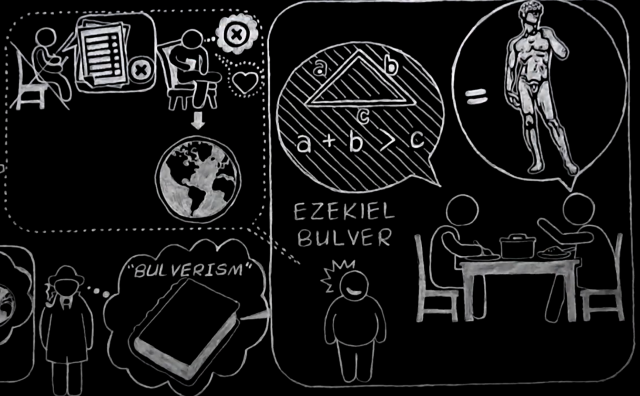
“Bulverism” is often said to be the name that C. S. Lewis gave to what has also been called “historical chauvinism,” or, in other words, a faulty appeal to progress. The exact fault in that appeal is that it is inevitable, or logically necessary that a position held in the future will be more true than one held in the past. However, the essay by that name reveals a broader target of Lewis’s criticism.
Lewis imagined a man named,
Ezekiel Bulver, whose destiny was determined at the age of five when he heard his mother say to his father — who had maintained that two sides of a triangle were together greater than the third — ‘Oh you say that because you are a man.’ ‘At that moment’, E. Bulver assures us, ‘there flashed across my opening mind the great truth that refutation is no necessary part of argument. Assume that your opponent is wrong, and explain his error, and the world will be at your feet. Attempt to prove that he is wrong or (worse still) try to find out whether he is wrong or right, and the national dynamism of our age will thrust you to the wall.’1
Now Lewis began by casting Freud and Marx is this mold, but we might as well add those other “masters of suspicion” from that same century—Feuerbach, Darwin, and Nietzsche—in order to notice a great transition from refutation concerning being to deconstruction of belief formation.
It is the difference between what Alvin Plantinga has called the de facto versus the de jure objections. The first says, “X is invalid or unsound—and here is my logic or evidence to show it.” The second says, “You only believe X because Y—X being a mental event or state inevitably brought about by Y.” The latter makes the claim that the means by which one came to the belief is somehow illegitimate, yet its “illegitimacy” has nothing to do with its correspondence to the specific objective realm to which the belief points.
Lewis’s argument against naturalism in the second chapter of his book on Miracles is instructive here. Some of it is channeled almost verbatim in the essay on Bulverism. For instance,
But our thoughts can only be accepted as a genuine insight under certain conditions. All beliefs have causes but a distinction must be drawn between (1) ordinary causes and (2) a special kind of cause called ‘a reason’. Causes are mindless events which can produce other results than beliefs. Reasons arise from axioms and inferences and affect only beliefs. Bulverism tries to show that the other man has causes and not reasons and that we have reasons and not causes. A belief which can be accounted for entirely in terms of causes is worthless.2
In this sort of deconstruction, just as in a naturalistic account of reasoning, reason itself has been abandoned. If nature is all there is, then the workings of the mind can be no exception. If everything is reduced to interlocking cause and effect, then mental events are also interlocking cause and effect. And if that is the case, it follows that nothing which does follow can be a real insight into the way the world is outside of our minds. All mental effects were as bound to take place as any other. None can serve as the ruler or standard over two or more competing claims: X versus ~X. That third thought (the standard) would have equally been the result of inevitable material motion. All deconstruction, then, collapses into that same cardinal difficulty of naturalism.
It would seem that Lewis was using this concept of Bulverism as a larger category than simply historical chauvinism, but rather for any dismissal of the validity of a position purely on belief-formation ground. A belief can be said to be “explained” on the grounds that the believer has a natural fear or wish fulfillment (Freud), a vested class interest (Marx), a projection of some human virtue (Feuerbach), a natural survival trait (Darwin), the arrest of will by slave morality (Nietzsche).
The beginner student of logic might recognize the common thread in all of these. They are all examples of the genetic fallacy. This error in reasoning dismisses a position as false because of its origin. That includes its cause in the mind, even on the level of motive. Psychological and sociological explanations for belief formation may be interesting. They may tell us much that we would like to know about the relationships between persons and their beliefs. As to whether or not those beliefs are true about the world, they tell us precisely nothing. They are nothing but an elaborate way to change the subject.
_____________________________________
1. C. S. Lewis, “‘Bulverism’ or the Foundation of 20th Century Thought,” in God in the Dock: Essays on Theology and Ethics (Grand Rapids: Eerdmans, 1997), 273.
2. Lewis, “Bulverism,” 275.