
Defining Justice: Book I of Plato’s Republic
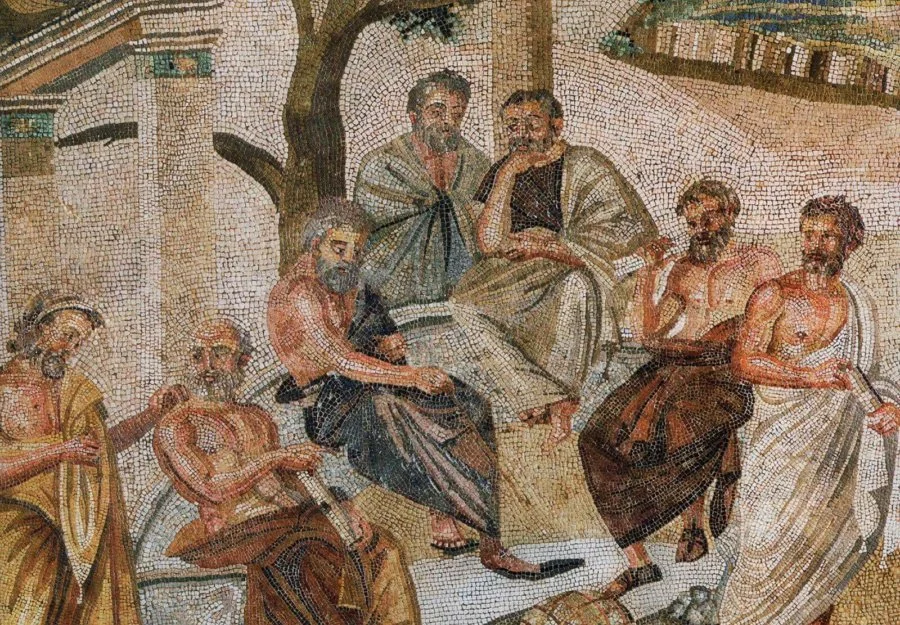
The opening scene is in the house of one Polemarchus in the midst of a religious feast. Friends of Socrates spot him trying to leave early and detain him for conversation, which begins with Cephalus, the father of Polemarchus, conversing about old age and whether the best life is past. Cephalus recalls the words of Sophocles that it is the character of the man that makes all the difference to what he looks back upon.1 What then, in this look back, is justice?
Polemarchus: Justice is Doing Good to One’s Friends
At his point, the son and homeowner, Polemarchus offers the first attempt at a definition. He cites one Simonides in saying that “it is just … to render to each his due.”2 But a thing can be called “due” to another either positively or negatively. We owe and we owe back. For example, all deserve the truth from us up front, but if we have lied to someone, we must clear the air. More vividly to the second example, we owe property back if we have stolen something.
Anyone who has read Plato’s other smaller dialogue on justice, namely the Euthyphro, will recall that this sort of an answer will not satisfy Socrates. So he asks, is it really “truthtelling and paying back what one has received … or may these very actions sometimes be just and sometimes unjust?”3 After the example of the friend gone mad—that in such a case, it would not be just to simply repay him what is due, since the weapons that are technically his, will do him harm—Socrates concludes, “Then this is not the definition of justice.”4 Polemarchus agrees, and adds, “for he [Simonides] believes that friends owe it to friends to do them some good and no evil.”5 Eventually this is expanded: “To do good to friends and evil to enemies, then, is justice in his meaning.”6
Many in our day have rediscovered this concept of the “friend-enemy distinction” mediated by the German political theorist Carl Schmidt.7 The context for such a recovery is the suspicion over several tenets of modern liberalism. Chief of all is an unyielding primacy of principles over power, of decorum and procedure over the spirit of the law that truth and justice would prevail. The folly in exalting the outer “letter” of law over the life of those who wrote it is captured in the line by Anton Chigurh in the movie, No Country for Old Men—“If the rules have brought you here, of what use were the rules?” It has been hardened into a rhetorical question that is itself unquestioned. We wield power for our friends; we are done with capitulating, in suicidal empathy, to those who we know very well mean us harm.
Would Plato have agreed with either side of our generational chasm? The reader should observe that neither friend nor enemy have been defined at this point. That is not insignificant, especially when one considers whether or not it can be justified to do good to this “friend” and not so much to this “enemy.” Both get what is “due” to them. It is a persistent idea.
After Socrates had taken Polemarchus through six or seven rounds of examples to show how his definition of justice was no definition at all, the latter hardly remembers what he himself means! But one thing he clings to: “Yet this I still believe, that justice benefits friends and harms enemies.”8
If we grant—as Polemarchus does—that the good are to be rewarded and the evil punished, then who our friends are is quite secondary. Socrates presses him as to whether such friends whose friendship is placed above the good are not rather enemies. Is he a good friend who does not care whether his friendship is good for one’s soul? “May I ask,” continues Socrates, “whether by friends you mean those who seem to a man to be worthy or those who really are so, even if they do not seem, and similarly of enemies?”9
Although it may seem odd to us, for the ancient Greeks it made perfect sense to approach such questions in terms of how they affect the soul. A good friend will make one better, and a bad friend will make one worse.
Given the opening conversation between Socrates and the other old man, it was the good life that was the setting of this question about justice. With that in mind, Socrates turns the quest for justice toward whether any “harm” caused by justice would make someone better or worse. It is reminiscent of the Apology when Socrates blamed them for choosing to punish rather than to educate and make him better. Perhaps there is still something important here. Following his examples of whether the action upon a horse or a dog would make them better or worse in virtue of being horses and dogs, he then concludes, “And is not justice the specific virtue of man? … Then it must also be admitted, my friend, that men who are harmed become more unjust.”10
In other words: Justice is its ability to advance itself in the soul of its recipients:
If, then, anyone affirms that it is just to render to each his due and he means by this that injury and harm is what is due to his enemies from the just man and benefits to his friends, he was no truly wise man who said it ... For it has been made clear to us that in no case is it just to harm anyone.11
It may be that Socrates’s pushback that justice does no harm is just that—not that the punishment that harms is not a necessary corollary of justice, but that it is not the essence.12
Thrasymachus: Justice is the Advantage of the Stronger
Halfway through, Thrasymachus interrupts, depicted as “a wild beast … as if he would tear us to pieces … [who] bawled out into our midst.”13 His basic definition is that: “the just is nothing else than the advantage of the stronger.”14 At first glance, this seems reasonable: not simply a crass declaration that might makes right. He says to Socrates:
Don’t you know then, said he, that some cities are governed by tyrants, in others democracy rules, in others aristocracy? … And is not this the thing that is strong and has the mastery in each—the ruling party? ... And each form of government enacts laws with a view to its own advantage.15
That is true enough. Certainly it would be unjust for a state to not do that which it took for the regime to survive and so plunge its people into chaos and ruin.
However, this is too charitable a reading of Thrasymachus. In fact, what he has in view is the ruler’s personal advantage. This assumes an inverse relationship between the ruler’s advantage and the people’s advantage.16 Thrasymachus lacked a conception of a common good.
Let us call Socrates’s first substantive objection the “fallible legislator problem.” Both men grant that obedience to rulers is just, and then Thrasymachus also accepts that they often commit error, and that enacting laws falsely implies that which is not to their advantage. “Then on your theory,” Socrates says, “it is just not only to do what is the advantage of the stronger but also the opposite, what is not to his advantage.”17 At this point he is caught.
But he plays it off as if he meant something else all along: “Do you suppose that I call one who is in error superior when he errs?”18 In this, he has a ready-made shapeshifter in office. When the ruler is in such error, he is not in fact the ruler, or at least, not the stronger. After all, he argues, the physician and the calculator are not so named insofar as they err, but only to the extent that they fulfill those roles. In a similar way, he is “the ruler in so far as the ruler does not err, and not erring he enacts what is best for himself.”19 The term STRONGER, then, in “Justice is the advantage of the stronger” must be relative to the office and not the man. But can this be done unless there is a form of the office? One must be a metaphysical realist to believe there is a form of ruler: an essential ruler and one who is only so-called. And that, Thrasymachus is not.
Socrates then concedes but asks for a definition.20 This immediately alerts the reader, who might have been initially impressed by Thrasymachus abstraction, toward this problem: How can any of us know WHEN the ruler is properly so called, or even WHETHER he is ever properly so called, if we cannot know by WHAT he is properly so called? The question becomes clarified as to whether “injustice is more profitable than justice.”21 The man who would be just gets the short end of the stick.22 Not only does the tyrant remove all obstacles from what he wants and is in fact called happy by all, but moreover, “it is not the fear of doing but of suffering wrong that calls forth the reproaches of those who revile injustice.”23
This is also analogized to the corporate level, as a city may be unjust and subject other states to tyranny, which Thrasymachus takes to conform to his virtue of power.24 This becomes what he calls “complete injustice” which is “able to subject to themselves cities and tribes of men.”25
The Socratic method is on display in Book I by two extended attempts to get Thrasymachus to see how he is in no real sense talking about justice.
The first strategic use of this method let us call the “advantage of arts problem.” In the case of a physician or a pilot, to what advantages is his art? Socrates reminds him, as he considers this, that the advantage must be primarily—if not exclusively, where ends are at odds—toward the stronger, and that strength being defined by the ruler or master of the art who knows when it is to his advantage.
But it turns out that the object of every art is the perfection of some object in need. In the case of medicine it is for the body, and for sailing, safety at sea. But as long as we are being abstract, what about the art itself?
For there is no defect or error at all that dwells in any art. Nor does it befit an art to seek the advantage of anything else than that of its object … Then medicine, said I, does not consider the advantage of medicine but of the body? Yes. Nor horsemanship but of horses … Then no art considers or enjoins the advantage of the stronger but every art that of the weaker which is ruled by it.26
Concessions were made, but not of defeat.
After defining more of his terms—such as the virtue of a thing being its strength to perform its proper function, and a defect as some deprivation of that virtue—using the examples of eyes to see, ears to hear, a pruning knife to trim, he then asks: “The soul, has it a work which you couldn’t accomplish with anything else in the world, as for example, management, rule, deliberation, and the like?”27
As all interlocutors with Socrates tend to do, an excuse is made and the scene ends with that aporia characteristic of those who are always learning but never coming to the knowledge of the truth.
_______________________________________________________________
1. Republic, I:329c-d
2. Republic, I:331e
3. Republic, I:331c
4. Republic, I:331d
5. Republic, I:332a
6. Republic, I:332d
7. Carl Schmidt, The Concept of the Political (Chicago: The University of Chicago Press, 1957)
8. Republic, I:334b
9. Republic, I:334c
10. Republic, I:335.b-c
11. Republic, I:335e
12. Republic, I:335c-336a
13. Republic, I:336b
14. Republic, I:338c
15. Republic, I:338d, e
16. Republic, I:338e
17. Republic, I:339d
18. Republic, I:340c
19. Republic, I:340e-341a
20. Republic, I:341b
21. Republic, I:345a
22. Republic, I:343d-e
23. Republic, I:344a-c
24. Republic, I:351b
25. Republic, I:348d
26. Republic, I:342a, b, c
27. Republic, I:353d