
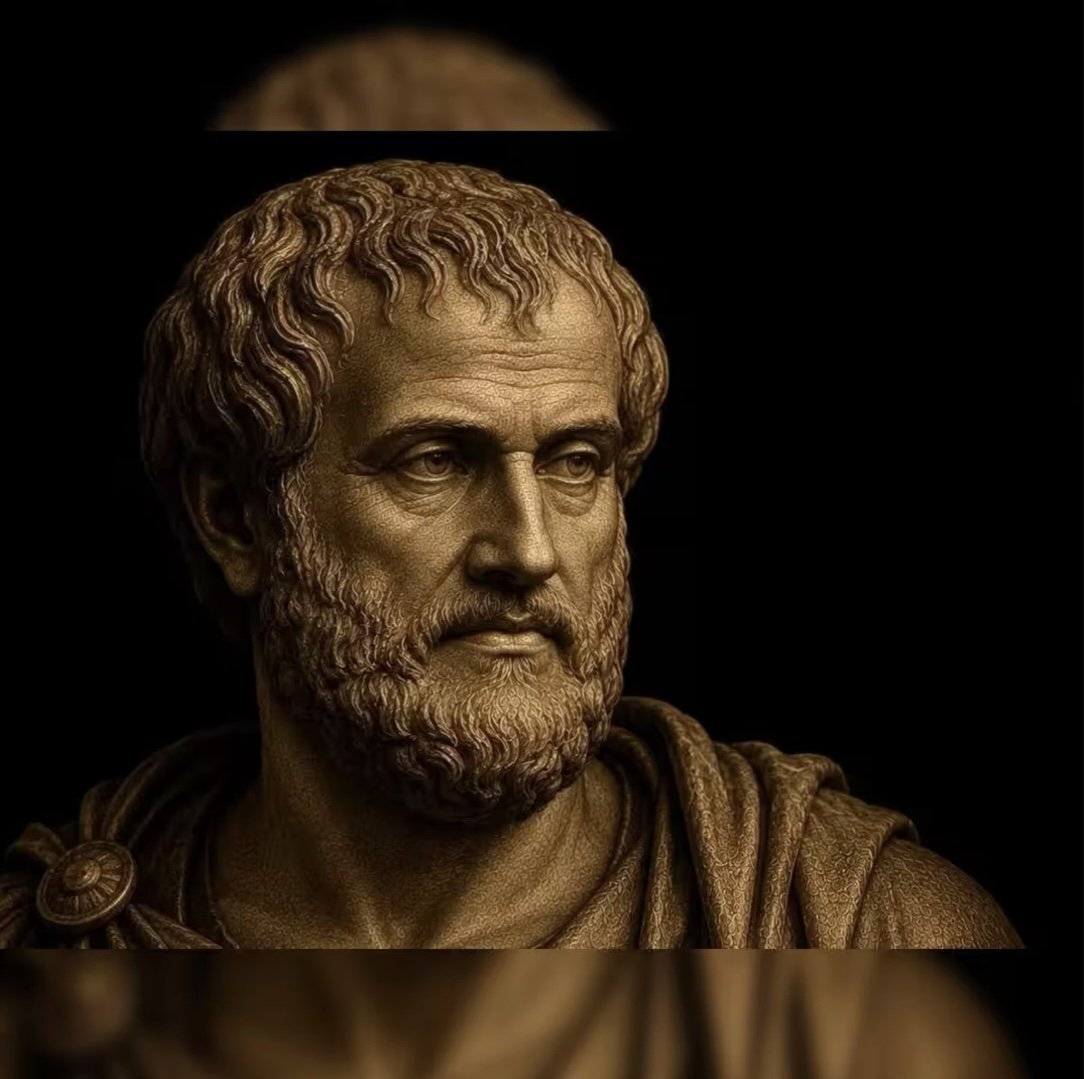
The title Metaphysics was not given by Aristotle himself, but by later followers. Nonetheless it perfectly describes the “science” or “wisdom” its author designed to construct. Those two words are instructive, and the student of Christian theology would do well to pay attention to how they are used through the course of the Philosopher’s most influential works.
Any attentive reader, no matter what his interest in this book, may easily discern in Book I that what we are witnessing is the origin of a new intellectual field of study. It makes the grandest of claims. However, that part was not Aristotle’s idea. In fact, for the majority of the first book, he takes us on a tour of those who might be called “philosophers” before him.
Unlike the arrogant modern intellectual, this pioneer of philosophy did not line up the whole lot of thinkers before himself and knock them all down with a yawn and a sneer. On the contrary, he paid them many thanks, for they had raised the ultimate questions of the one and the many, of the permanent and changeable, and of what must be the supreme, or first principle (arche) which sets them all in motion or even maintains their existence. Without these questions, philosophy would never get off the ground.
On the other hand, these who came before Socrates especially—hence the common name “pre-Socratics”—did not quite push through. He summarizes the present state of the big questions: “in a sense they have all been described before, in a sense they have not been described at all. For the earliest philosophy is, on all subjects, like one who lisps, since it is young and in its beginnings.”1
We Already Assume Such a Science
Metaphysics is a difficult work, yet its opening “problems,” if we want to speak of them in that way, may be set in simple terms, as its author in fact does. He begins with something of a natural or universal drive in all human beings. Man has a natural desire to know. To such as who exercise this desire it becomes clear that the one who knows the causes of things is wise, whereas the one who merely practices this or that art has experience alone. Similarly the one who studies some branch of knowledge (scientia) may content himself with the surface of describing how the things he studies happen to move about. He has only science and not wisdom.
Now each of those arts and sciences involve causes. There are causes in he who acts, he who makes, and he who knows; and there are also causes in that which is done, that which is made, and that which is known. Yet among causes in each art or science there must be those more ultimate than others, and again, above all arts and sciences there are certain principles and causes shared by all. These are “above” the whole class of arts and sciences, as none of these arts and sciences “below” effect or produce or explain the more universal or general principles or causes. Consequently, there must be a science of these—even a “divine science”—and he who sees this, as Aristotle both sees and shows this, are most wise.
Contrary to one of modern philosophy’s typical misunderstandings, Aristotle, no less than other classical thinkers, had an epistemology. That metaphysics was “first philosophy” meant just that, but not that it was “alone philosophy.” The point was that what we know and how we know is wholly determined by what is. At any rate, he offers a rudimentary epistemology in showing sensation to be most simple, memory to be an advance of this, and then experience as a construct of several memories, which, through this experience man may derive science and art. “Now art arises when from many notions gained by experience one universal judgment about a class of objects is produced.”2
We receive the first hints of Aristotle’s “scientific” approach, in that the man of experience has more knowledge of individuals, whereas the man of theory has knowledge of universals in addition. So the latter knows more by extension, but the former knows more by intension—i.e., knows more about his particular subject matter, and to that degree is more scientific. On the other hand, this man of “art,” or theory, has a knowledge that comprises wisdom, as he seeks the knowledge of causes.3
The upshot is that fundamental claim of premodern thought against the pretensions of modernism: “All men suppose what is called Wisdom to deal with the first causes and the principles of things … [so that] the man of experience is thought to be wiser than the possessors of any sense-perception whatever.”4 Another claim, equally fundamental but perhaps not as widely known—though anyone familiar with the appropriation of these categories to theology by Thomas Aquinas may recognize its origin here:
And those most exact of the sciences are those which deal with first principles; for those which involve fewer principles are more exact than those which involve additional principles, e.g. arithmetic than geometry. But the science which investigates causes is also instructive, in a higher degree, for the people who instruct us are those who tell the causes of each thing. And understanding and knowledge pursued for their own sake are found most in the knowledge of that which is most knowable … and the first principles and causes are most knowable; for by reason of these, and from these, all other things come to be known.5
There is a lot here and we cannot go so far as to prove the point. For anyone who is content to grant it, but wants to understand it further, think only of the sun. Here is an object of such radiance that it cannot be taken in directly, yet nothing else can be seen without it. Plato would at least approve of that imagery—cf. his use of the “sun” as an analogy of the Good in Book VI of the Republic, and the function of the same in his cave analogy in Book VII.
The claim amounts to this: That which is first and fundamental is also most knowable. That seems paradoxical. Aristotle is about to show us how the first thinkers who might be called philosophers began “on the ground,” so to speak, with material moving around. They then advanced to those more immaterial things by means of abstraction. This is harder. Was it not the blinding nature of the sun outside the cave that caused so much difficulty for Plato’s philosopher to escape his chains and then tell others? Indeed it was. Aristotle is not unaware of the paradox. But so it is, that that which is more difficult to come to in ourselves is actually most perfectly plain in itself. The composite cannot get its splintered little gaze around the one; but, if only he could, then he would see that which all the other points and lines are “made of,” so to speak.
We might put these two fundamental claims in a syllogism.
1. All that which is most knowable is of the highest science.
2. First principles and ultimate causes are most knowable.
∴ First principles and ultimate causes are of the highest science.
While, as already stated, the title Metaphysics is not his, Aristotle does not fail to deliver a precise definition.
There is a science which investigates being qua being and the attributes which belong to this in virtue of its own nature. Now this is not the same as any of the so-called special sciences; for none of these others treats universally of being as being. They cut off a part of being and investigate the attributes of this part; this is what the mathematical sciences for instance do.6
This comes later, the opening words to Book IV, yet it is worth stating here for the sake of clarity.
Never Rising Above the Material
The Pre-Socratics made a good start yet never graduated. But from what did they fail to graduate? His answer is clear: “Of the first philosophers, then, most thought the principles which were of the nature of matter were the only principles of all things.”7 What was the first principle to everything else? Each had his own explanation, typically arranged in a general school. I will paint with a broad brush here. Thales put forth water, Anaximanes air, Heraclitus fire, Empedocles four elements (earth, air, fire, water), and Anaxagoras, that these are infinite. At this point, Aristotle suggests, “the only cause is the so-called material cause; but as men thus advanced, the very facts opened the way for them and joined in forcing them to investigate the subject.”8
Interestingly, an advance by Empedocles, and those of his school, at least grasped, “two of the causes which we distinguished in our work on nature—the matter and the source of the movement.” In short, this primitive step before philosophy is roughly where modern scientists have largely degenerated toward. The oversimplification lies in seeing only two things: 1. immediate prior causal agents, and 2. the material composition of things acted on by those agents: e.g., that they are of such and such a nature, and can this only produce x range of effects. Although, even here, most evolutionary theory and transgenderism are glaring examples where they cannot even be consistent with this boastful dragging of the knuckles.
Back to Aristotle’s narrative, the lowest stage of at least trying to understand the origins of matter in motion, gave rise (to any whose minds who penetrate beneath the surface) to a second stage or level, or, in other words, kind of cause. “For at least the substratum itself does not make itself change,” in other words, regardless of which element is the focus, so that “something else is the cause of the change. And to seek this is to seek the second cause.”9
Anaxagoras is acknowledged to have the most transcendent idea, but it is still criticized: “For Anaxagoras uses reason as a deus ex machina for the making of the world, and when he is at a loss to tell from what cause something necessarily is, then he drags reason in, but in all other cases ascribes events to anything rather than to reason.”10
The Pythagoreans treated the matter too simply or superficially. Although he had less room for Parmenides treating all as one, the Pythagoreans, while admitting two basic principles, made them come to the same. They were unity and infinity. And to say that all is made up of numbers, even if by resemblance begs the questions about how the one has being, and how what is first came to cause anything else.
Chapters 7 and 8, which may seem as though they are merely being repetitive, seem to be covering the field specifically as to the problem with holding to one cause or anything less than the four, or more materially, as none of it really accounts for change or the thing that a substance is.
The Case Against His Master Plato
There is continuity and discontinuity between these two titans of Greek philosophy. Both are crucial to understand in order to understand all else that follows; and I mean that in the most far-reaching way. While they may have overstated who have said All subsequent philosophy in the West is but a “footnote” to Plato or to Aristotle—yet, they have captured a truth.
Plato’s word “participation” Aristotle took to be the renaming, with some reconceiving, of Pythagoras’s use of imitation—that is, of sensible things imitating numbers.11 He gives a clearer summary of where Plato placed mathematical objects than Plato himself did, at least in Republic VI, where he discussed the divided line. Here it says,
besides sensible things and Forms … there are the objects of mathematics, which occupy an intermediate position, different from sensible things in being eternal and unchangeable, from Forms in that there are many alike, while the Form itself is in each case unique … But he agreed with the Pythagoreans in saying that the One is substance and not a predicate of something else.12
It is difficult to enumerate in a precise order the criticisms of Plato by Aristotle. For one thing, there is overlap between them. More importantly, however, he keeps circling back to them throughout the work. I say that is more important because it is in that retracing of these critical steps where we gain more insight into the continuity and discontinuity that becomes the two pillars of Western philosophy.
If we fail to appreciate the discontinuity, we will be blind to the diversity of methods by which subsequent philosophers seek answers to these questions, or perhaps attempt (mostly unsuccessfully) to frame different questions. If, on the other hand, we fail to appreciate the continuity, we may forget that these two divergent lines are, after all, both pillars, so that what they have in a common foundation far exceeds their differences, at least when compared to the modern attempts to depart from any semblance of rationality and reality.
With that in mind, let us take a brief glance at the pupil’s critique of his master. The first problem with the Platonists has to do with causality of the forms: “For they make many things out of the matter, and the form generates only once, but what we observe is that one table is made from one matter, while the man who applies the form, though he is one, makes many tables.” It is not perfectly plain why this position is incoherent, except that its analysis is insufficient, as it employs “only two causes, that of the essence and the material cause.”13
In chapter 9, he begins to more carefully enumerate the problems with Platonic forms: (1) they add to the many that which they sought to explain by the one; (2) arguments for their existence are not convincing; (3) some are of relations yielding no independent class; (4) the “third man” problem; (5) they give no account of their causal relationship to sensible things; (6) “it would seem impossible that the substance and that of which it is a substance should exist apart”; and (7) we could not come to know that which is purely ideal if all knowledge begins by what is already known—whether deductively, by true definitions, or by induction.14
A further criticism of Plato comes later, in Book III, in Aristotle’s treatment of the basic difficulties in constructing this science of being. To be specific, it may be asked what the exact nature is of that which is neither perishable or imperishable, supremely intelligible or sensible. Why should such a question be asked of Plato? This middle thing—this “becoming”—is what Plato called Intermediates. But this presents several problems which Aristotle in that place.15
If Aristotle held the pre-Socratics in high regard, much more did he do so with Plato. This is evident in other works, as when he says in the Ethics that the doctrine of Ideas will not be able to help him with the “good” he has in mind as the end cause of virtue. He signals regret at saying so, because of his fondness for the authors of that doctrine. But so it is, that while we must love our friends and teachers who have brought us so far, we must love truth even more.16
As one reads the Metaphysics, one will find more understanding by remembering to ask what Plato might say to a particular criticism, or what he might offer in the place of that which Aristotle does. Appreciation and continuity aside, it must be acknowledged that where Aristotle picks up from Plato, he does not believe that such a science has been credibly, or at least certainly not adequately, delivered to the true lover of wisdom.
______________________________________
1. Aristotle, Metaphysics, I.10, in The Basic Works of Aristotle (New York: Modern Library, 2001), 711.
2. Aristotle, Metaphysics, I.1 [689].
3. Aristotle, Metaphysics, I.1 [690].
4. Aristotle, Metaphysics, I.1 [691].
5. Aristotle, Metaphysics, I.2 [691-92].
6. Aristotle, Metaphysics, IV.1 [731].
7. Aristotle, Metaphysics, I.3 [693].
8. Aristotle, Metaphysics, I.3 [694-95].
9. Aristotle, Metaphysics, I.3 [695].
10. Aristotle, Metaphysics, I.4 [697].
11. Aristotle, Metaphysics, I.6 [701].
12. Aristotle, Metaphysics, I.6 [701].
13. Aristotle, Metaphysics, I.6 [701-02].
14. Aristotle, Metaphysics, I.9 [706-11].
15. Aristotle, Metaphysics, III.2 [720-21].
16. Aristotle, Ethics, I.6 [939].