
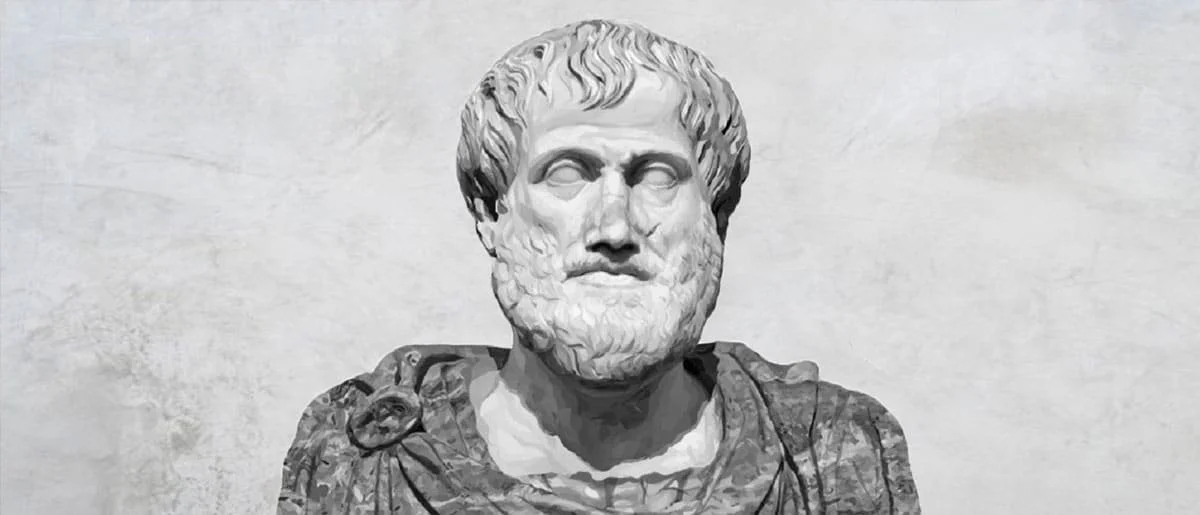
We will treat Books II and III together, the second book being very brief and providing for us a useful review and bridge between the essence of metaphysics and its elements.
In Book I, Aristotle compared the wise man of philosophy to the master workman who knows not only how to make a thing, but knows its causes.
It is right also that philosophy should be called knowledge of the truth. For the end of theoretical knowledge is truth, while that of practical knowledge is action (for even if they consider how practical things are, practical men do not study the eternal, but what is relative in the present).1
We know a bit of the truth in knowing the things other disciplines study, yet these are not ultimate. If philosophy was only looking after causes, it would be no higher than the other sciences. In fact, it would not exist at all. Aristotle had already shown how the thinkers who came before Socrates had already sought material cause. Thus to know the truth of things immediately suggests a greater realm of causality.
Now we do not know a truth without its cause; and a thing has a quality in a higher degree than other things if in virtue of it the similar quality belongs to other things as well (e.g. fire is the hottest of things; for it is the cause of the heat of all other things); so that which causes derivative truths to be true is most true.2
There are higher sciences because there are greater things.
Four Causes and a First Cause
When Aristotle first mentions his four causes, he does not call them by the names we have come to know them. He does give them those names, but not at first.
Evidently we have to acquire knowledge of the original causes (for we say we know each thing only when we think we recognize its first cause), and causes are spoken of in four senses. In one of these we mean the substance, i.e., the essence (for the ‘why’ is reducible finally to the definition, and the ultimate ‘why’ is a cause and principle); in another the matter or substratum, in a third the source of the change, and in a fourth the cause opposed to this, the purpose and the good (for this is the end of all generation and change).3
Further, “the final cause is an end, and that sort of end which is not for the sake of something else, but for whose sake everything else is.”4 If we prefer the most succinct and clear summary, the one offered by Mortimer Adler may be preferable.
1. Material cause: that out of which something is made.
2. Efficient cause: that by which something is made.
3. Formal cause: that into which something is made.
4. Final cause: that for the sake of which something is made.5
There must be a first cause to all. Such reasoning begins in exactly the way one would expect who is familiar with the first way to show God’s existence, developed by Thomas Aquinas.6 We all observe things in motion, and each moved thing must be moved by another. This process cannot go on to infinity. This is true both about causes to events before our own as well as to ends that move our most immediate set of ends and means. If either procession were infinite, then either being itself or the good would be eliminated. Consequently, there would be neither knowable causes of things at all, nor principles by which we can know them.
Nor does the reality of infinite sets in mathematics upset this necessity, for causes to things are not merely formal: “(It makes no difference whether there is one intermediate or more, nor whether they are infinite or finite in number.) But of series which are infinite in this way, and of the infinite in general, all the parts down to that now present are alike intermediates; so that if there is no first there is no cause at all.”7
This first cause must be indestructible: “At the same time it is impossible that the first cause, being eternal, should be destroyed; for since the process of becoming is not infinite in the upward direction, that which is the first thing by whose destruction something came to be must be non-eternal.”8 Later on, Aristotle will throw us for a loop if we are thinking merely in terms of a “lower” and “upper” story of the visible and invisible, for the Greeks held there to be an eternally fixed Celestial Sphere, so that that which moves in a perfect circle has such qualities. Now that is not the end of the reasoning, but we must be patient readers to see how he works it out.
One Science, Many Problems
Aristotle tackles basic difficulties, the answers for which metaphysics is summoned. There are fourteen questions to be exact: (1) Are causes of one or more sciences? (2) Are these first principles of substance or of all rational inquiry? (3) Is there one science for all substances? (4) What all exists? (5) Is it of existence only or essence as well? (6) Are attributes predicated of or present in? (7) If those are genera, are they proximate or ultimate? (8) Are there causes other than material? (9) Are principles limited in number or kind, in definitions or the substratum? (10) Are there perishable things only or imperishable—and are their principles the same? (11) Are unity and being the “attributes of something else but the substance of existing thing” or that “the substratum is something else”? (12) Are principles universal or like individual things? (13) Are principles potential or actual? (14) Are mathematical objects substances—if so, are they predicated of or present in sensibles?
As an example of how these help us arrive at metaphysics as much as they begin to chart the course of this science, the question about causes will suffice. Different subjects feature different causes, or different levels of the same causes. Some seem to have none at all, such as mathematics, which certainly have no final causes (no obvious good). He uses the example of the causes of a house. It exhibits all, yet these all exist above and beyond architecture. This must be of the science of wisdom. All things belong to it in general. We also know the causes better when we know the source of the movements, but none of the particular sciences know the ultimate origin of their movements.
Difficulties must be addressed up front. This is “because people who inquire without first stating the difficulties are like those who do not know where they have to go … for the end is not clear to such a man … Further, he who has heard all the contending arguments, as if they were the parties to a case, must be in a better position for judging.”9
Note also that the word “principles” is used here as “first things” rather than as axioms or presuppositions. That will become standard in classical theology as much as in philosophy. What comes into focus in these first few books is that this first philosophy is first in such a way that to know what it studies is to know everything else at the principle level. This should not be lightly dismissed.
Someone may say, “Well, sure, but only at the principle level,” as if all we are talking about are certain tools for thinking or rudimentary pieces of knowledge such as the ABCs. In fact, first philosophy acquires a knowledge of content of such a kind that all other kinds of knowledge stand upon its foundation. Where it stands, they stand. Where it is denied, they dissipate. The things it knows by intellectual focus, others may grasp hold of by intuition, by practical necessity, or by faith. On the other hand, to know the sense in which one knows it is to know it indeed, and thus to know all other things by leaps and bounds more than he who knows not.
But inasmuch as it was described as dealing with the first causes and that which is in the highest sense object of knowledge, the science of substance must be of the nature of Wisdom. For since men may know the same thing in many ways, we say that he who recognizes what a thing is by its being so and so knows more fully than he who recognizes it by its not being so and so, and in the former class itself one knows more fully than another, and he knows most fully who knows what a thing is, not he who knows its quantity or quality or what it can by nature do or have done to it.10
As it is in metaphysics, so it is in theology. He who knows the One according to His true substance has a far better grasp on what is properly said and metaphorically said of God as He is revealed in the narrative of Scripture or in the flow of history or in relation to creatures. He who knows all other things “by its being,” that is, by its participation in the being of God knows not only God more truly but all other things more fully, since these exist in relation to Him.
__________________________________________
1. Aristotle, Metaphysics, II.1 [712].
2. Aristotle, Metaphysics, II.1 [712-13].
3. Aristotle, Metaphysics, I.3 [693].
4. Aristotle, Metaphysics, II.2 [714].
5. Mortimer J. Adler, Aristotle for Everybody: Difficult Thought Made Easy (New York: Macmillan Publishing, 1978), 42.
6. Thomas Aquinas, Summa theologiae, Ia.2.3.
7. Aristotle, Metaphysics, II.2 [713].
8. Aristotle, Metaphysics, II.2 [714].
9. Aristotle, Metaphysics, III.1 [716].
10. Aristotle, Metaphysics, III.2 [718].