
The Word Makes the Church, Part 1
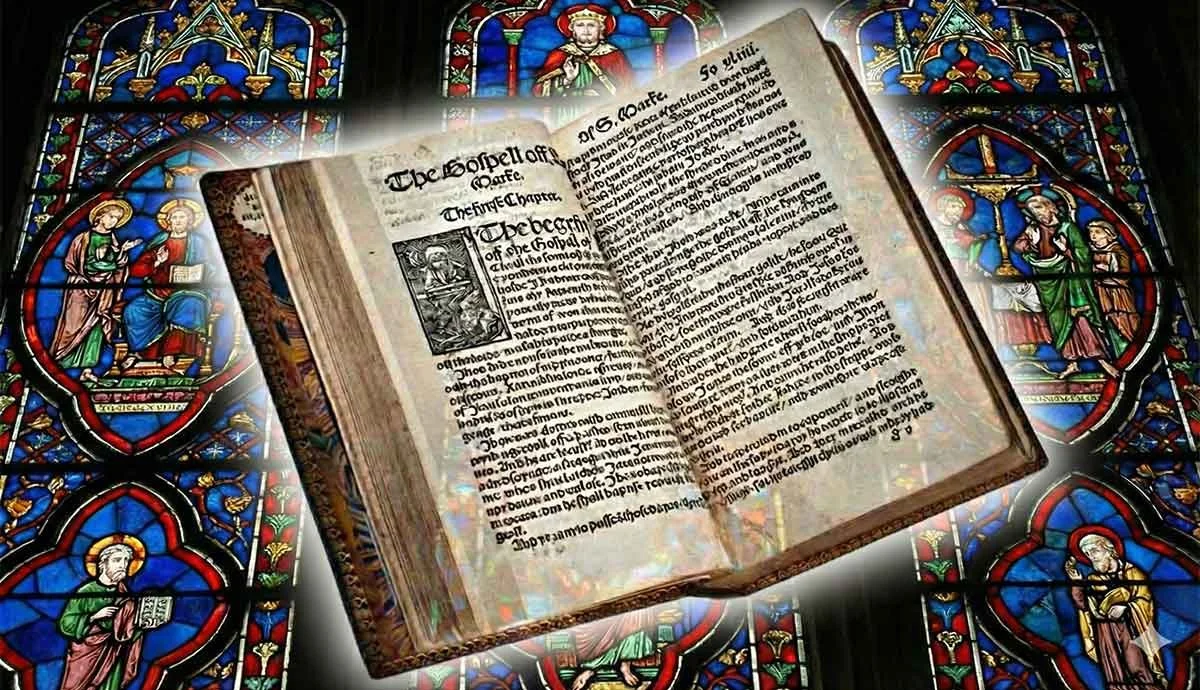
One of the most profound undercurrents in Calvin’s Institutes is the place that he gives to the word of God. This clearly features in his polemic against idols (Book I, Chapters 10-12), but even more prominently in his whole ecclesiology, or doctrine of the church (Book IV). This is much more than a pious commitment of Calvin’s, though it is certainly that. There are metaphysical implications that shape how one views life as a whole. What I would draw the reader’s attention to is how this emphasis makes for a distinct philosophy of ministry. Although Calvin is my starting point here, it should be acknowledged that what follows is not a mere historical reconnaissance into his thought. What I got out of this—when I finally got down to reading the whole of the Institutes two decades ago—is more expansive. Calvin was only one source, even if a main one. I trust that my location of the principle in some proof-texts below is a faithful representation of the Scriptures.
That said, I would first propose a fundamental principle and five corollaries for our view toward ecclesiology.
Fundamental Principle. Everything moves from the invisible to the visible
Corollary 1. God is invisible, and, of His effects, that which is invisible about them is what is most real (its form).
Corollary 2. The creative word is that by which God moves all things to their form (act).
Corollary 3. The propositional word (spoken or written) is that by which God calls (imperative or indicative) all things as to their form (act).
Corollary 4. The mind is that by which the rational creature discerns the form: distinguishing essential from accidental, the hierarchy of these within each form and between all forms.
Corollary 5. The church has a form: that which is more essential being more invisible, that which is more accidental being more visible.
More corollaries could be added regarding the mind’s way of perceiving the what and the why of each, but this will suffice to introduce the same ideas through more familiar paths. I have six such “paths” in mind. In each of these we will see how the word of God makes the church. By “make” here, I will mean that in all of the ordinary senses, such as: creates, shapes, informs, ensures, etc. Since this is a vast subject, I will divide this study into two parts, here covering the three first paths of the word moving from the invisible to the visible.
(i.) The Word Makes the Church’s Being
(ii.) The Word Makes the Church’s Marks
(iii.) The Word Makes the Church’s Unity
The Word Makes the Church’s Being
The meaning of the word “church” in both Hebrew (קָהַל) and Greek (ἐκκλησία) speaks of an assembly. It is true that these can be any congregation of people, even secular crowds, as in one passage in Acts. However, in context, the word is used to mean an assembly specially called out of the world for worship. The who and the what of this calling are plain: God calls by His word. A weak way to understand this is to recognize that the call of the word comes first, so that of course it is causal in the same way that mom’s dinner bell caused the children to run inside and gather for dinner. That responsive gathering is where the symmetry ends. Mother did not have to create new children in order to give them the taste for dinner. God did have to create new hearts for the feast that never ends.
Observe that in the Bible, everything new began by God’s word:
By the word of the LORD the heavens were made … For he spoke, and it came to be; he commanded, and it stood firm (Ps. 33:6, 9)
By faith we understand that the universe was created by the word of God, so that what is seen was not made out of things that are visible (Heb. 11:3)
When God called Abraham to go to Canaan (Gen. 12:1) and called Moses and the multitude out of Egypt (Ex. 3:4), He did so by His word. When each new prophet was called and went he first opened his mouth to the people, what then? “Now the word of the LORD came to me” (Jer. 1:4). So it is with the church. This is true in the first place because each new citizen of the kingdom is created by the new birth, in which the Spirit uses the word.
For God, who said, “Let light shine out of darkness,” has shone in our hearts to give the light of the knowledge of the glory of God in the face of Jesus Christ (2 Cor. 4:6)
Of his own will he brought us forth by the word of truth, that we should be a kind of firstfruits of his creatures (Jam. 1:18)
since you have been born again, not of perishable seed but of imperishable, through the living and abiding word of God (1 Pet. 1:23)
In one sense, things might seem to be the other way around. Do not we embodied souls discover the invisible depths only by passing through the visible surface? We pass through water to learn what it represents. We must put the bread and wine to our lips in a carnal way even if we would taste and see that the Lord is good. Paul even speaks of redemptive history in this way. It is the way of bodies, “But it is not the spiritual that is first but the natural, and then the spiritual” (1 Cor. 15:46).
All true, yet nothing to the point. Our question was not the order of knowing, but of the order of being. And it is precisely being which we want to know.
Thus in ecclesiology, when theologians speak of the distinction between the invisible church and the visible church, they are not only recognizing a distinction but also a proper order. We define the invisible church as the elect as known by God (2 Tim. 2:19), gathered with all elect angels and saints in heavenly Jerusalem (Heb. 12:22-23). We define the visible church as the mixed body as it assembles on earth.
Bavinck wrote that “the church was called ‘visible’ because it manifests itself in its confession and conduct, or acts institutionally with its offices and ministries, or because it not only contains true believers but also hypocrites.”1
Now in terms of ordering these, Turretin wrote,
[W]hatever things constitute the church properly so called are internal and invisible: election and effectual calling, union with Christ, the Spirit, faith, regeneration and the writing of the law on the heart, the reasonable (logikos) and spiritual worship.2
Seeing the invisible through the visible is the first step to realizing that the invisible is more real. Then, an ordered reality can emerge in one’s mind. A view of what philosophers call metaphysics, that is, a view of what is most essentially, and therefore the greatest causes of things. Everything in reality moves from the invisible to the visible—first, from the God who is infinite and spirit to all creatures as His effects; to second, from formal reality embedded in all secondary causes, whether mathematical or moral; to third, from the operations of lesser minds, whether angels or men, to their effects. The church is not somehow exempt from this same objective reality.
The Word Makes the Church’s Marks
How do we come to the church? Or, perhaps a better initial question—How do we come to God? Obviously the answer is that we come to God by Christ alone (e.g., John 14:6). However, most Christian theologians would acknowledge that the church plays a role in that. Calvin was no different in that respect; and for he and his contemporaries, this was a matter of life and death. They had to have a good answer the question posed to Luther: Where was your church, brother Martin, before the sixteenth century? If being apart from the true church was to be a part from Christ, then schismatics—such as the Protestants were charges with being—would face death in this world for something that would only bring them eternal death. They had to be right about how to tell the true church from the false.
Calvin had to wrestle with the meaning of Augustine’s statement that he would not know God as Father without having the church as mother.
Augustine, therefore, does not here say that the faith of the godly is founded on the authority of the Church; nor does he mean that the certainty of the gospel depends upon it; he merely says that unbelievers would have no certainty of the gospel, so as thereby to win Christ, were they not influenced by the consent of the Church … that those who are not yet enlightened by the Spirit of God, become teachable by reverence for the Church, and thus submit to learn the faith of Christ from the gospel. In this way, though the authority of the Church leads us on, and prepares us to believe in the gospel, it is plain that Augustine would have the certainty of the godly to rest on a very different foundation.3
For all of us in every century, the identity of the true church is at stake. Are there any distinguishing marks? Whether it be Rome assailing the Protestant churches as false because they are schismatic or novel, or whether the young men of our day wildly search for an “authority” to hold on to as civilization slips away under their feet, to what sure marks shall we point?
Calvin’s first statement is all-important.
Wherever we see the word of God sincerely preached and heard, wherever we see the sacraments administered according to the institution of Christ, there we cannot have any doubt that the Church of God has some existence, since his promise cannot fail, ‘Where two or three are gathered together in my name, there am I in the midst of them’ (Mt. 18:20).4
When the Reformed have spoken of the word as the primary mark of the church, what they have meant is twofold. First, there must be the preached word: “And how are they to hear without someone preaching?” (Rom. 10:14) That means the word is not only read, but explained and applied. Second, that which is central to the word must be brought to the forefront, namely, the gospel word. In the 1 Peter 1:23 text, we saw that the imperishable seed that creates spiritual life is the word. Two verses down Peter gets more specific: “And this word is the good news that was preached to you” (v. 25).
This ought to cultivate in us what has been called the judgment of charity in looking out at others:
When we say that the pure ministry of the word and pure celebration of the sacraments is a fit pledge and earnest, so that we may safely recognise a church in every society in which both exist, our meaning is, that we are never to discard it so long as these remain, though it may otherwise teem with numerous faults. Nay, even in the administration of word and sacraments defects may creep in which ought not to alienate us from its communion.5
Before there were three “Reformed marks” of the church, the credal language had always suggested four more general—I believe in one holy catholic and apostolic Church. Each of these must also be viewed from the invisible to the visible, lest they become their very opposites and a material mockery of the genuine article. Think about it. The very notion of one is mathematical, formal, and thus immaterial, having as its seat of existence in the divine mind. When a thing is “one” on earth, it is, as Jesus even prayed, that we would be one as He and the Father were one (see John 17:21). It is an essential oneness, not an accidental oneness—it is a oneness at one with all that is in God, not a oneness with a fraction of contingent reality, which may get along well enough with the devil or some more minor defect, but which is not one with He who is one in Himself.
Catholicity is universality, the very opposite of Romanism; and by the standard of those marks, it is Rome that was found wanting. Here,
instead of the ministry of the word, prevails a perverted government, compounded of lies, a government which partly extinguishes, partly suppresses, the pure light. In place of the Lord’s Supper, the foulest sacrilege has entered, the worship of God is deformed by a varied mass of intolerable superstitions; doctrine (without which Christianity exists not) is wholly buried and exploded, the public assemblies are schools of idolatry and impiety.6
“Wherefore,” Calvin concludes, “in declining fatal participation in such wickedness, we run no risk of being dissevered from the Church of Christ. The communion of the Church was not instituted to be a chain to bind us in idolatry, impiety, ignorance of God, and other kinds of evil, but rather to retain us in the fear of God and obedience of the truth.”7
Rome’s appeal to a catholicity of externals paralleled the ancient Jews according to Calvin,
In the present day, therefore, the presence of the Romanists is just the same as that which appears to have been formerly used by the Jews, when the Prophets of the Lord charged them with blindness, impiety, and idolatry. For as the Jews proudly vaunted of their temple, ceremonies, and priesthood, by which, with strong reason, as they supposed, they measured the Church, so, instead of the Church, we are presented by the Romanists with certain external masks, which often are far from being connected with the Church, and without which the Church can perfectly exist. Wherefore, we need no other argument to refute them than that with which Jeremiah opposed the foolish confidence of the Jews—namely, “Trust ye not in lying words, saying, The temple of the Lord, The temple of the Lord, The temple of the Lord are these” (Jer. 7:4). The Lord recognises nothing as his own, save when his word is heard and religiously observed.8
In this way, Calvin argues, the papists “terrify the unskilful with the name of Church” and “dazzle the eyes of the simple.”9 With what? The passing external shadows over the pure light of immutable, immaterial essence. Those who take the external and material surface of things as that which is most real about a thing, Calvin suggests, have simple minds. They are driven, like animals, outside of their brains, through the senses, to the motions that come and go, rather than by that more excellent faculty of their soul, moving outward from finite mind to infinite mind by that more rigorous method of thought.
To speak of the church as holy must avoid two ditches—one is a carnal Christianity where the Spirit by the word changes nothing; the other is a perfectionism where we boast in the flesh, which is to boast in externals (as the Pharisee in Luke 18:11-12), or severity to the body as Paul warned against in Colossians 2:23. Likewise with personal holiness and sin, Calvin echoed Augustine’s condemnation of the Donatists: “For there always have been persons who, imbued with a false persuasion of absolute holiness, as if they had already become a kind of aerial spirits, spurn the society of all in whom they see that something human still remains … Such in the present day are some of the Anabaptists.”10 The examples of the Prophets in the Old Testament and Apostles in the New are used by Calvin to show that we remain in God’s present house as long as possible, calling to repentance before that point of no return.11
He then adds,
I say not that wherever the word is preached fruit immediately appears; but that in every place where it is received, and has a fixed abode, it uniformly displays its efficacy. Be this as it may, when the preaching of the gospel is reverently heard, and the sacraments are not neglected, there for the time the face of the Church appears without deception or ambiguity and no man may with impunity spurn her authority, or reject her admonitions, or resist her counsels, or make sport of her censures, far less revolt from her, and violate her unity (see Chap. 2 sec. 1, 10, and Chap. 8 sec. 12).12
Thus the Reformed marks make the ecumenical marks—the word makes holiness, since by the word the mind and heart are sanctified (Jn. 17:17) or washed (Eph. 5:26) or transformed (Rom. 12:2) or purified in hope (1 Jn. 3:4).
As to that last of the ecumenical marks, it is a mistake to think that the Reformers had no category for the apostolic. To the contrary, they located apostolic succession in what the Apostles taught, rather than in any material pedigree. Again—the invisible to the visible. Calvin says, “It follows, therefore, that the pretence of succession is vain, if posterity do not retain the truth of Christ, which was handed down to them by their fathers, safe and uncorrupted, and continue in it.”13 To exalt mere men without respect to that which makes a man more than a beast is one sure way to degrade the man before me and devolve the mind within me.
The Word Makes the Church’s Unity
Calvin’s crucial statement on the relationship between doctrine and church unity comes at this point:
For all the heads of true doctrine are not in the same position. Some are so necessary to be known, that all must hold them to be fixed and undoubted as the proper essentials of religion: for instance, that God is one, that Christ is God, and the Son of God, that our salvation depends on the mercy of God, and the like. Others, again, which are the subject of controversy among the churches, do not destroy the unity of the faith.14
Notice two things about this passage. The first is that this list is not exhaustive, but exemplary. The second comes in the expression “unity of the faith.” Calvin’s larger subject matter in this section is the unity of the body. What then is this unity of the faith and how might it be related? He later cites Augustine to make the same point, concluding that “the thing to be observed is, that this union of charity so depends on unity of faith, as to have in it its beginning, its end, in fine, its only rule.”15 This makes sense. If the word makes the church, then the essential content in the “DNA” of the body of Christ is the information in its doctrinal strands.
In a book on healing the divisions among God’s people, Jeremiah Burroughs once put it in this way,
When they divided from God, they divided from His people … If you are divided from the truth, what can hold you together? Truth is a single, simple, plain thing; but error is various and ensnarls itself with infinite contradictions. If people go out of the plain path of truth, they wander up and down God knows whither, entangling themselves in briars and thorns so that they cannot extricate themselves.16
This is the way the Bible speaks. Division of the body is blamed on dividing from the truth—at least when doctrine is the source of the division.
I appeal to you, brothers, to watch out for those who cause divisions and create obstacles contrary to the doctrine that you have been taught; avoid them (Rom. 16:17).
As for a person who stirs up division, after warning him once and then twice, have nothing more to do with him (Titus 3:10).
for there must be factions among you in order that those who are genuine among you may be recognized (1 Cor. 11:19).
Likewise when Jude says, “It is these who cause divisions” (v. 19) in his very short epistle, it is simple enough to trace out the same cause there as well. These passages collectively paint the picture of heresy dividing from orthodoxy. Two ingredients are necessary. There is a rejection of some essential doctrine, but there is also some individual (or group of individuals) who are commending that doctrine to the church.
These are not cases of new believers in a small group study or some dear old saint who is a mature believer but could likely not articulate Nicene Trinitarian orthodoxy or the precise differences between justification and sanctification. No—this is someone setting themselves up as a teacher, and so leading others astray.
Think of the three stages of heresy dividing from orthodoxy as (1) reject, (2) relate, and (3) recruit. In other words, an essential is rejected; but, since all essential doctrines are intricately related to many other Christian truths, it begins an unraveling process, because other related doctrines will have to be reconfigured to account for the distortion. Finally, the would-be teacher commends a growing, gaping black hole of belief.
Calvin links the word to The Word in making the most Essential one the opposite of division. In doing so, he comes full circle from the matter of the word making the church’s unity to the word making the true church plain for all to see if they would but look past the visible surface.
Accordingly, he declares that when heresies and schisms arise, it is because men return not to the origin of the truth, because they seek not the head, because they keep not the doctrine of the heavenly Master. Let them now go and clamour against us as heretics for having withdrawn from their Church, since the only cause of our estrangement is, that they cannot tolerate a pure profession of the truth.17
There is a two-sided duty, to protect the peace wherever one can, but to not be unequally yoked where true doctrine and law has been trampled upon. He says, “If it holds the order instituted by the Lord in word and sacraments there will be no deception; we may safely pay it the honour due to a church: on the other hand, if it exhibit itself without word and sacraments, we must in this case be no less careful to avoid the imposture than we were to shun pride and presumption in the other.”18 Two ditches are thus avoided—tearing asunder what God has put together, and that over nothing of importance, and, on the other side, contenting oneself in a Peace, Peace! where there is no peace.
(To be Continued)
______________________________________________________
1. Bavinck, Reformed Dogmatics, IV:290.
2. Turretin, Institutes, III.18.7.9.
3. Calvin, Institutes, I.7.3.
4. Calvin, Institutes, IV.1.9.
5. Calvin, Institutes, IV.1.12.
6. Calvin, Institutes, IV.2.2.
7. Calvin, Institutes, IV.2.2.
8. Calvin, Institutes, IV.2.4.
9. Calvin, Institutes, IV.2.3.
10. Calvin, Institutes, IV.1.13.
11. Calvin, Institutes, IV.1.18, 1.27, 2.11.
12. Calvin, Institutes, IV.1.10.
13. Calvin, Institutes, IV.2.2.
14. Calvin, Institutes, IV.1.12.
15. Calvin, Institutes, IV.2.5.
16. Jeremiah Burroughs, Irenicum: Healing the Divisions Among God’s People (Morgan, PA: Soli Deo Gloria Publications, 1997), 15.
17. Calvin, Institutes, IV.2.6.
18. Calvin, Institutes, IV.1.11.