
What is Meant by ‘Christian Nationalism’? Four Models
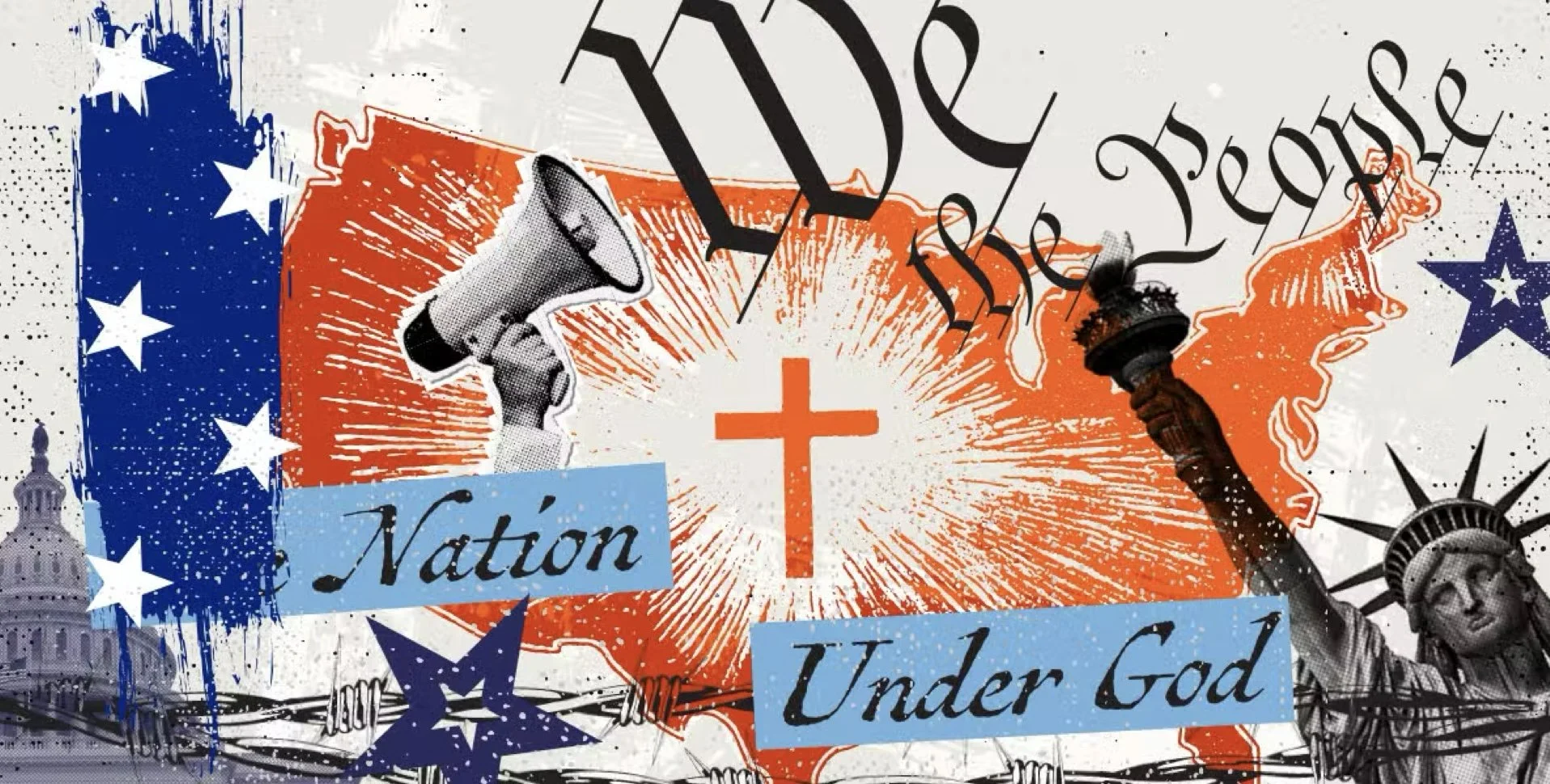
There is no official or universally agreed upon definition of Christian Nationalism.
The term is used as a pejorative by the mainstream media in a similar way that the term “fundamentalist” was used in the previous generations. Among those who apply the label to themselves, there seems to be diversity as well.
For the purposes of keeping things simple, we may identify four things as being meant by “Christian Nationalism,” whether they should be conceived on a spectrum or not.
Model 1. There is what some might consider a “Vanilla Christian Nationalism” that is both a pejorative from the Left and a real designation. This terrain would be peopled by an assortment of genuinely conservative Christians who identify with 1990s conservatism as communicated by Fox News and the conservative talk radio of that era. Such will be admirers of Winston Churchill and Ronald Reagan. They still tend to view unfettered global markets, legal immigration, and military interventionism as unrelated, at least in any negative sense, to the erosion of national sovereignty. They follow the rules of the system and hold the elements of federalism to be sacrosanct. Since there is no theoretical attempt in this model to base the totality of the political philosophy on Christianity, it may be asked: Why even include this as a model? The reason is simple. The label will be used by the enemies of Christians in any event. If one is asking, as a novice, how this label is being used, well, one of the answers will be that it is being used quite thoughtlessly, and you might as well know that.
Model 2. There is what Senator Josh Hawley, in a 2024 article in First Things, attempted to root in Augustine and the American founding, which speaks of “common loves” in minimalist faith, family, and flag terminology. Such commonality could be anything from a point only slightly to the right of a pluralist position, to more strict exclusion of violent modern ideologies. Here one might find conservative southern Baptists and even many of the older theonomists. This is likely where Charlie Kirk would have found himself for the majority of the years leading up to his death, though there were indications of his own movement further to the right throughout 2025. This model is distinguished from the first only in the sense that it does not mind the name and is more explicit in relating Christian principles to conservative principles. In short, the only difference between the first two models is that this model is more self-consciously Christian in their politics, yet hesitant to associate themselves with what they have heard on a popular level about “those Christian Nationalists,” an identity made up of whatever the latest mob has taken offense at and whoever can be shown to be their friends.
Model 3. This is the most articulate Case for Christian Nationalism, such as in the book written by Stephen Wolfe by that title, as well as the follow-up on Reformed Christian Politics, which Wolfe co-authored with Zachary Garris and Sean McGowan, not to mention the regular articles featured in American Reformer magazine. To go right to what many would consider to be the most controversial dimension: the language of “heritage Americans.” In this model, that heritage status is a religious-ethnic composition. In other words, though it points to the reality and the good of loving one’s people and the cohesion that can only be found in such a basic hegemony, it is not to be confused with any racial determinism or animus. The “stock” of Anglo generations responsible for the beginnings of this nation are preserved because of who they are—a love for ancestors and posterity alike—and because of what their people produced via Christian truths and mores. I call this a “composition,” to use Aristotelian language of matter (people and place) and form (principles). This is made essential for the maintenance of the culture, and the culture in turn for the political order. That common good is also self-consciously Christian.
Every word of the definition given by Wolfe is important to understanding this model:
Christian nationalism is a totality of national action, consisting of civil laws and social customs, conducted by a Christian nation as a Christian nation, in order to procure for itself both earthly and heavenly good in Christ.1
An evaluation is that definition would require a separate essay.
Model 4. There is finally a view that gives ultimate place to what is called race realism. I do not pretend to be an expert at the nuances within this view. A self-consciously materialist account would find in Darwinian evolution a scientific basis for all racial differences. Attempts to seek a biblical footing in the curse of Ham are not new. Anyone who accepts the Genesis account of that curse already accepts that God is within His right to providentially order history with extended differences between people groups, and that He has in fact done so, at least in the ancient world. The question becomes: How is this determinative for politics? In this view, the blood-and-soil link to culture is not only primary, but totalizing. Consequently the racially segregating emphasis crowds out any universal principle emphasis.
Summary Observations
One good reason for a beginner’s typology of this sort is to get beyond the very unchristian practice of slandering those with whom we disagree. For instance, we should not conflate any of these categories with each other. Of course that assumes that my little classification is accurate. This is not intended to be a final word on the subject, so I am open to whatever corrections prove compelling.
The concept of “natural affections” and the denial of a “propositional nation” are frequently cited by both Models 3 and 4. However, in Model 4, while natural affections are not wholly incompatible with spiritual affections in terms of church membership, they are a decisive factor for political inclusion. Likewise, in Model 4 there can be no ultimate appeal to unity via propositions to which members of other ethnic groups could assent in the meaningfully inclusive sense.
Finally, it should be said that the vast majority of what people think about these topics is communicated on social media in ways that are short, crude, and often in attempts to trap others so as to either have them cancelled, or use other innocent bystanders to that same end. If the bystanders will not cooperate in that inquisition, they themselves are swept up in the same guilt by association. To say that this is not the best method for mutual learning would be understatement.
____________________________________________________________________________________
1. Stephen Wolfe, The Case for Christian Nationalism (Moscow, ID: Canon Press, 2022), 9.