
Introducing The Mosaic Polity
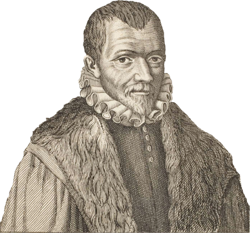
One of the foundational texts to read in our present recovery of Reformed political theory is The Mosaic Polity written by Franciscus Junius in 1593. François du Jon [his French name prior to Latinization] was born in 1545 in Bourges, where he began to study law at age twelve. His first influences, then, were French and Italian humanists appropriating the Justinian Code to modern law. Junius lived in Lyon from 1560-62, during which time he served with a French diplomat to the Ottoman sultan, Suleiman I. After a brief crisis of faith, hearing lectures on the thought of Cicero and Epicurus, he recommitted himself to Christ and went to study under Calvin and Beza in Geneva for three years.
In 1565 he took a call to pastor a church in Antwerp, Belgium. With the spread of the Inquisition northward, Junius fled to Heidelberg in 1568, doing pastoral and chaplain work, then returning to the Antwerp church until 1573. He would contribute to biblical scholarship, even with a translation of the Bible. Political upheavals in the Palatinate caused Junius to be driven out and then back at Heidelberg. By 1592 he would be appointed professor at Leiden where he would author his most profound works. After dying by the plague in 1602, his chair was filled by Jacob Arminius.
An Overview of the Text
The Mosaic Polity is organized by eight chapters, containing thirty-eight theses. It begins with a thoroughly Thomist conception of the division of law into eternal, natural, divine, and human; but launches out from there to that law more supernaturally directed to the greater end in Scripture. Indeed even the legal dimension of the Bible is to be considered superior. This is really analogous to conversations about doctrine in which one must often step back and ask whether our audience is committed to the Bible as the word of God to begin with. If he is not, then we have a non-starter. Similarly in ethics, we will often discover, only by probing, whether our interlocutors suspect that something in the Old Testament laws are barbaric or otherwise irrelevant.
So Junius writes,
If, however, we should turn to compare the laws of Moses with all those others, then it would certainly be unjust to God, their author, and to Moses, a faithful servant in the whole house of God, if we did not acknowledge that in the laws of Moses there is a perfection that is divine and greater in every way.1
His preface shows that he meant this as something analogous to a “position paper” for the infant Dutch State. It is addressed “To the illustrious States General of Holland, most noble men, and most distinguished lords …”2 and was written and published the year before he published his other major work now in print, De theologia vera. If it is asked what business this topic is to theologians, Junius had an answer for that.
And, in fact, we have said that the nature of this question is partly common to all human beings as human beings and it pertains to all those who are in authority as they have been called to public office, and, second, it does indeed have a certain particular rationale, because the latter specifically pertains to a politician and the former to a theologian … Theologians and servants of God build general and specific conclusions upon the natural principles in the divinely inspired science, and abstaining from individual determinations accommodate to human society and order.3
The reader must understand that The Mosaic Polity is neither political science nor biblical theology. In their introduction to the work, Todd M. Rester and Andrew M. McGinnis write,
We do not find either a political system or an extensive analysis of all the facets of the Hebrew Republic. Instead, Junius’ text is more of a prolegomenon to such political systems and studies … The prolegomenal nature of Junius’ Mosaic Polity is evident from the outset of the treatise. He notes that, as a theologian, his calling is to help clarify the biblical subject matter and to point the way forward for its proper observance in the republic.4
Aside from Scripture itself, we can speak of three basic sources of Junius’s political thought: first, the “consent of the nations” reasoning in Cicero and Seneca; second, certain “unnamed ‘scholastics,’” though “many of these references are either to Thomas Aquinas or to distinctions that were relatively standard in the medieval tradition”;5 third, the Corpus Iuris Civilis, or Roman Civil Law, published by Justinian I in 529.
The Definition of Law
One basic concept in the text itself is worth including in this introduction. Thesis 1 says “Law is the ordering of reason to the common good established by the one who has care of the community.”6 This definition given by Junius is almost verbatim at one with that given by Thomas Aquinas. For him,
[Law] is nothing else than an ordinance of reason for the common good, made by him who has care of the community, and promulgated.7
Both versions of the definition contain four parts. Junius even subjects his definition to causal analysis as was typical of Reformed theologians in dealing with a wide variety of issues. The efficient cause of law is one who has care of the community. The material cause is reason. The formal cause is “ordering,” that is of relations: as in principles to circumstances, principles to conclusions, lex to ius, and ius to ius in a hierarchy. The final cause is the common good.8
In the first place, law is rational. It is of reason, through reason, and to reason.
Junius describes this as a triple mode, namely: (1) the reason of the one who orders, (2) the reason of those who are governed by the ordering, and (3) that very reason of ordering intervening between both. “If one of these is lacking, it is not properly called a law.”9
This makes practical sense. A citizenry that does not understand the laws it is under is reduced to a collection of either animals or criminals. They would be mere animals if the only “law” meant was descriptive, such as the law of gravity or some law in the biological realm. They would inevitably be criminals if the laws were either too complex to understand—such as is our present tax code—or intentionally absurd so as to trap them—such as the often unwritten rules on speech concerning race. Hence the laws must make sense, both linguistically and morally, and this “sense” is a property of reason.
This certainly explains how reason must be operative between the law and the law-keeper; but what about the law-maker? Junius calls reason “the matter of law.” What he means is that “the whole work of reason is deposited in the distinction between the just and the unjust.”10 This immediately takes us into an abstract place to which we shall return. Simply note that the reason of the legislator has before his mind the true difference between what is just and what is unjust, and (assuming that he is a just law-maker) he will fashion the rationale of the law after the form of the just.
The second element of the definition is the ordering, or, as Thomas put it, ordinance. He quotes Cicero “in book one of The Laws that the law ‘is the highest reason, inherent in nature, which enjoins what must be done and forbids the opposite.”11 The emphasis on right reason, Junius says, is figurative. It is more properly “the ordering of reason. For the genus is the ordering, which is an act ... that is, showing the relation between the one who orders and those who are under the ordering.”12 This is actually crucial to the distinction between law and custom, as both are an ordering, but the species of the former is rational. Order is a state, yet ordering is an action brining about that state.
In considering these first two elements, one must factor in both the mind and will of the legislator. The definition given by Junius, like Aquinas, is a reflection of metaphysical realism rather than voluntarism. That is to say, it privileges mind over will in explanations of the way God made the world and the reason for God’s commandments, whereas voluntarism would explain these in terms of God’s will apart from any reason rooted in the nature of things. Junius makes plain where he stands on that question:
Therefore, let us call the matter of law reason, as the subject, and the whole work of reason is deposited in the distinction between the just and unjust, which work intercedes between superiors that are in charge and inferiors beneath them. For even if the law, as it is an act, is properly attributed to the will (because acts are from the will), yet because an act here is ruled by reason which prevails over the will, it is quite appropriate that this act is entirely attributed to reason as the master rather than to the will as its assistant. In fact, the form of that act is called an ordering because it is the nature of all related things that the very relation intervening between two related terms should properly constitute the form of the thing enacted.13
The third element to law is that it has the common good as its end. The word “commonwealth” comes from the Latin communes, but also the old English word weal, which essentially meant good or even blessing. To speak of a “common good” is not to speak of a leveling of “common goods.” In other words, it is not a veiled reference to anything like communism or even any form of collectivism. It simply affirms that man is a political animal, as Aristotle observed. To say that law is for the common good is nothing other than to say that law is ordered to direct the nature of man as he is, which is in his life together with others.
Finally, there is the element of the lawgiver having care of the community. Each community is different. Later on in this book, the issue of how common notions are drawn out to different conclusions and determinations according to differing circumstances of time and place. But in this sense, politics will be an art of properly relating the universal to the particular, the common to the diverse.
Another source for Junius was the Roman writer Gaius. He would say that,
Every people that is governed by statutes and customs observes partly its own peculiar law and partly the law common to all mankind. That law which a people establishes for itself is peculiar to it, and is called ius civile as being the special law of that state, while the law that natural reason establishes among all mankind is followed by all peoples alike, and is called ius gentium as being the law observed by all mankind.14
Rester and McGinnis summarize this distinction in their Introduction as saying that, “every legal code in every nation is a mixture or composite, being ‘partly its own peculiar law and partly the law common to all mankind.’”15 “Gaius is also a source of the definition of lex that persists in the Western legal tradition, which he simply states this way: ‘A lex is what the people order and establish.’ In English translation these two terms for law—ius and lex—are particularly troublesome to distinguish due to the broad range of meanings.”16
These distinctions serve as a bridge from law’s definition to its most basic divisions. That there is a difference between the justice in the law—the reason of the law—and the law in its “legislated” form, calls attention to a hierarchy of law. It is that relationship between eternal, natural, divine, and human laws that we will examine next.
____________________________________________________________
1. Franciscus Junius, The Mosaic Polity (Grand Rapids: Christian’s Library Press, 2015), 6.
2. Junius, The Mosaic Polity, 3.
3. Junius, The Mosaic Polity, 21, 23.
4. Todd M. Rester and Andrew M. McGinnis, Introduction to The Mosaic Polity, xlvi.
5. Rester and McGinnis, Introduction to The Mosaic Polity, xxx.
6. Junius, The Mosaic Polity, 38.
7. Thomas Aquinas, Summa theologiae, I-II.90.4.
8. Junius, The Mosaic Polity, 40.
9. Junius, The Mosaic Polity, 40.
10. Junius, The Mosaic Polity, 40.
11. Junius, The Mosaic Polity, 39.
12. Junius, The Mosaic Polity, 39.
13. Junius, The Mosaic Polity, 40.
14. Gaius, Institutes of Roman Law, I.1., cited in Intr., xxxi.
15. Rester and McGinnis, Introduction to The Mosaic Polity, xxxii.
16. Rester and McGinnis, Introduction to The Mosaic Polity, xxxii.