
Let’s Grow Up and Work With God!
Sermon on Sunday, August 5, 2018
But I, brothers, could not address you as spiritual people, but as people of the flesh, as infants in Christ. I fed you with milk, not solid food, for you were not ready for it. And even now you are not yet ready, for you are still of the flesh. For while there is jealousy and strife among you, are you not of the flesh and behaving only in a human way? For when one says, “I follow Paul,” and another, “I follow Apollos,” are you not being merely human? What then is Apollos? What is Paul? Servants through whom you believed, as the Lord assigned to each. I planted, Apollos watered, but God gave the growth. So neither he who plants nor he who waters is anything, but only God who gives the growth. He who plants and he who waters are one, and each will receive his wages according to his labor. For we are God’s fellow workers. You are God’s field, God’s building.
1 Corinthians 3:1-9
I am sure you have all heard the expression: “missing the forest for the trees.” We use this expression when someone misses the big picture of anything because they are fixating on a small part. At times we can even settle for little lives because we suffer from a kind of petty nearsightedness, so that our obsession with the tree is actually a moral issue. In many situations, we actually have a responsibility to see the big picture. Part of maturity is to see more of the big picture and leave behind little games. One easy way to only be able to fixate on a tree and be ignorant that you are in a forest is to be a baby or a toddler. We would hardly blame an infant for missing the forest for the tree. However, what if there was such a thing as forced infancy? What if we could actually refuse the kind of nourishment, the kind of diet, that it requires to grow up and see that big picture? That is Paul’s point in this passage.
But is this not too edgy? “Grow up and work with God!” One might even suspect both insult and heresy together in one place. We do not build with God in the same way that He does. Certainly not in the same way, and yet, here is Paul risking insult to sensibilities and feigned orthodoxy. See these in the two parts to this message:
All Christians Grow Up (vv. 1-4)
All Christians Work With God (vv. 5-9)
Doctrine. All Christians are called to grow up and work with God on His church.
All Christians Grow Up
I say this, and yet the Corinthians were not so grown up. Note here that there is (i.) the reality of immaturity, (ii.) the diet of immaturity, (iii.) the evidence of immaturity, and then (iv.) the particular manifestation of immaturity.
First, the REALITY of immaturity. ‘But I, brothers, could not address you as spiritual people, but as people of the flesh, as infants in Christ’ (v. 1). To repeat, Paul is not saying they are unsaved. It is only that their mindset is inappropriate: as flesh people. As an important side note, this passage is often taken as proof of there being two kinds of Christians: spiritual and carnal. Every lie is a twisted truth. There is a sense in which there is carnality clinging to the Christian. But because that is clearly not a good thing, that does not imply what advocates of “carnal Christianity” want it to. The whole tone of Paul is that this is unnatural and inappropriate. What exactly is the problem? Their infancy. There is an appropriate kind of infancy in Christ—namely, when we first come to Christ. Staying infantile, however, is not appropriate. So maturity is not optional. We “are to grow up” (Eph. 4:15). Every Christian will mature at different rates and in different ways, but God does not bring any half-baked Christians into glory.
Second, the DIET of immaturity. ‘I fed you with milk, not solid food, for you were not ready for it. And even now you are not yet ready, for you are still of the flesh’ (vv. 2-3a). Following from the first point, Paul is not talking about an appropriate infant’s diet as in the “pure spiritual milk” (1 Pet. 2:2), but rather as the author of Hebrews puts it,
You need milk, not solid food, for everyone who lives on milk is unskilled in the word of righteousness, since he is a child. But solid food is for the mature, for those who have their powers of discernment trained by constant practice to distinguish good from evil (Heb. 5:12-14)
The author of Hebrews leaves us in no doubt that this is blameworthy pushing away the meat at the dinner table, because just before he says, “since you have become dull of hearing. For though by this time you ought to be teachers” (vv. 11-12). So what we have, both in the Hebrews passage and this Corinthian passage, is church culture that is sinfully conspiring to keep everything shallow—except that in the Corinthian case, you have that bizarrely combined with pretending that they are deep, spiritual superstars.
Third, the EVIDENCE of immaturity. ‘For while there is jealousy and strife among you, are you not of the flesh and behaving only in a human way?’ (v. 3b) Jealousy and strife are Paul’s two pieces of hard evidence that these Corinthians need this moment back at the “woodshed.” In effect, he is saying: No, I regret to inform you, brothers and sisters, that you are not where you think you are. Your boasts, your comparisons, your petty grievances, your impressions of the way things ought to be, are not the sage wisdom that you think they are. And I know that because you are striving for things that God has not given, and you are setting up people to compete for positions that God does not have for them. You do not sound as spiritual as you think you do. You are speaking out of the discontentment of the flesh.
Fourth, the PARTICULAR MANIFESTATION of immaturity. ‘For when one says, “I follow Paul,” and another, “I follow Apollos,” are you not being merely human?’ (v. 4). Here we see the echo of the concern from Chapter 1: party spirit. They cannot get on with the meat because they cannot stop seeing human reflections in that milk! Solid teachers are a gift from God (Eph. 4:11) and even imitating faithful leaders, a command from God (Heb. 13:7); but following behind, and falling into a trance at, mere humans, as an end in itself, that is another story.
Thus, contrary to what the Corinthians were doing, all Christians grow up. Note that this growth is not an individualistic thing. What is it that all Christians grow up for, or in what way?
All Christians Work With God
Theologically, Paul works backward here: from correcting the Corinthians to the true nature of everyone’s place, to the amazing fact that we are actually, in some way, co-laborers with God, with what He is doing. In other words, here we have: (i.) the dignity of the worker, (ii.) the role of the worker, (iii.) the reward of the worker, and (iv.) the reality of the work.
First, the DIGNITY of the worker. ‘What then is Apollos? What is Paul? Servants through whom you believed, as the Lord assigned to each’ (v. 5). What is the design of teachers in the church? Here Paul is reviewing the product as belief. Note that the belief that is cultivated by ministers of God does not end at that initial belief produced by the new birth. It is not merely the first flickering of faith. If it was, one would only need a single consolation with an evangelist, and no pastor or teacher thereafter. This feeding of faith is the constant service of church teachers. Now if that is true, then what does this demand of the hearers that Paul is addressing here? It is simply to believe. Nor is this restricted to the central things about the gospel; and not only the mysterious first things about creation or last things about the Second Coming. Nor are these driven to become information that I can take home to win arguments on social media.
I am writing these things to you so that, if I delay, you may know how one ought to behave in the household of God (1 Tim. 3:14-15).
So, to return to the rhetorical question he asks: What then is Apollos or Paul or your pastor or any other pastor you could have? Answer: they are servants to present to you a constant crisis of truths to be believed, to submit to, as the very words of God.1 They are servants to set you in motion with more of God’s mission. And if that is not what you are getting out of it, yes you are in sin. You will also stunt your own growth.
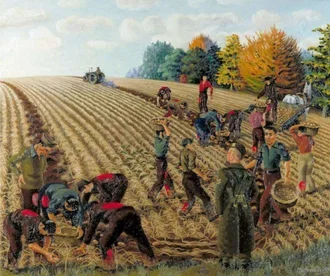
Second, the ROLE of the worker. ‘I planted, Apollos watered, but God gave the growth. So neither he who plants nor he who waters is anything, but only God who gives the growth’ (vv. 6-7). What we are going to see even more vividly in Chapter 12 is that there is a division of labor in the body of Christ. Applied to Paul’s point here, there is a division of labor even among ministers of the gospel. But Paul already drops a clue here with very particular imagery. It is agricultural imagery. God is working on a field: a vineyard in many places in Scripture (cf. Is. 5, Jn. 15). And in that field-image, God uses co-laborers. Think of the words of Jesus:
Then he said to his disciples, “The harvest is plentiful, but the laborers are few;therefore pray earnestly to the Lord of the harvest to send out laborers into his harvest” (Mat. 9:37-38).
All that imagery of meat versus milk back in the mess hall was for energy out in the fields. The nourishment was for a great and glorious harvest. But the key in verses 6 and 7 is not simply that God is the sovereign, ultimate cause of those spiritual crops growing, but that Paul and Apollos have different skill sets, and we are no more at liberty to look down on one of those laborers than we are to try to do God’s job for Him. Both of those truths are in play in this imagery.
Third, there is the REWARD of the worker. ‘He who plants and he who waters are one, and each will receive his wages according to his labor’ (v. 8). When the workers are mature, they are in sync. Remember 1:10? “One mind.” They are in such a state of unity because they have one expectation, one ultimate reward. Now in another sense, rewards are diverse. The Bible speaks of a “thirtyfold, sixtyfold, hundredfold” produce (Mk. 4:8), and that the Lord will render to each according to what we have done (cf. Mat. 16:27, Rom. 2:6).
Some will come to this passage with entirely foreign, yet understandable, concerns. Any talk of rewards attached to human action becomes the proverbial hammer when everything is a nail. In this case, the “nail” is justification, and the “hammer” is faith alone. The problem is quite simple: Paul’s primary subject matter is not soteriology here. Even where there are secondary implications of soteriology, as the passage continues, his subject is still not the grounds of justification.
Many need to hear that Paul’s appeal to rewards for work done here does not contradict the gospel truth that we are justified before God by faith alone, and in the performance of Christ alone. His work is what makes us acceptable to God. But there are additional rewards attached to what we do out in God’s field. In fact, in the very next breath of this chapter, there seems to be gradations of good works and glory (3:10-15). That has its place. Yet even that is not where Paul begins. He begins in one great divine work in order to lift our eyes from the petty and passing to the great and the lasting. Paul and Apollos are not competing. We are not rivals! Paul elsewhere uses the word “rivalries” and continues that “those who do such things will not inherit the kingdom of God” (Gal. 5:20, 21). Rivalries with other Christians is most un-Christian.
These Corinthians are also not auditioning for whatever the ancient version of American Idol was. Nor should any era of Christians do so at church. Notice Paul says that each gets ‘wages’ and that these are ‘according to his labor’—not according to his “success” and not according to any other criteria but what his Master has sent him here to do.
Fourth, there is the REALITY of the worker. ‘For we are God’s fellow workers. You are God’s field, God’s building’ (v. 9). God is working on us; and we are working with Him. The Corinthians have been gathering around, staring at their own reflection in the shiny fruit, or mesmerized by other mere branches and offshoots of the vine, and they have missed the eternal harvest. This is the ultimate case of missing the forest for the trees: when the forest is the King’s forest that grows into eternity and the outer bark of the tree and its leaves fade.
Even the Lord’s servants come and go. And while our souls last forever, and so does our produce, our use down here is not something to grasp hold of: much less the impression of our use in the eyes of others. The idea that we are God’s field (or building) suggests something eternal is being built right here in time. While I think the words of Count Zinzendorf have been often abused in a pietistic vein, there is nonetheless a kernel of truth in the words: “Preach the gospel, die and be forgotten.” God does not forget us, and we are to honor those who have gone before us. Yet our motive is not the esteem of mere mortals.
To summarize the two pieces of imagery together, the immature “flesh-person” elevates mere mortals, pits them against each other, in some short-sighted wishlist for their leaders. Such Christians are either territorial about what they do have (“Us four, no more, shut the door”) or else they live in a constant state of spiritual wanderlust for what they don’t have. As such, they never graduate from milk to meat to harvest. But the “spirit-person” knows that God sends whoever God sends, and makes them into very particular workers with very particular gifts, and we just get to work with the horses we find in the stalls. Sometimes things really are that simple: Let’s all grow up and get to work!
Practical Use of the Doctrine
Use 1. Admonition. For many of us before we can even hear “Let’s get to work!” in the right way, we need to get back to basics: back to that pure spiritual milk. ‘What then is Apollos? What is Paul? Servants through whom you believed. When all else fails, come back to what we most need to believe. Jesus crucified in His flesh even all of our petty rivalries. He was taken out of his own vineyard and cursed upon a tree (Gal. 3:13); he was that grain that fell to the earth and died so that he would bear much fruit in us (John 12:24). He was crushed that we would flourish. He was sent down that we would grow up.
Use 2. Exhortation. Are you not getting out on that field—or are you not even graduating from milk to meat— because you are striving to get Paul to water, or Apollos to plant, or either of them to make the sun shine, or to till the soil, or to gather more laborers, or to maintain the farm equipment? If that is you—if you are in a season of such striving—then I would commend to you a season of taking in that milk and meat and really digesting it for what it is worth. Consider its nourishing end out in the field.
________________________________________________
1. 1 Thessalonians 2:13