
She Who is at Babylon
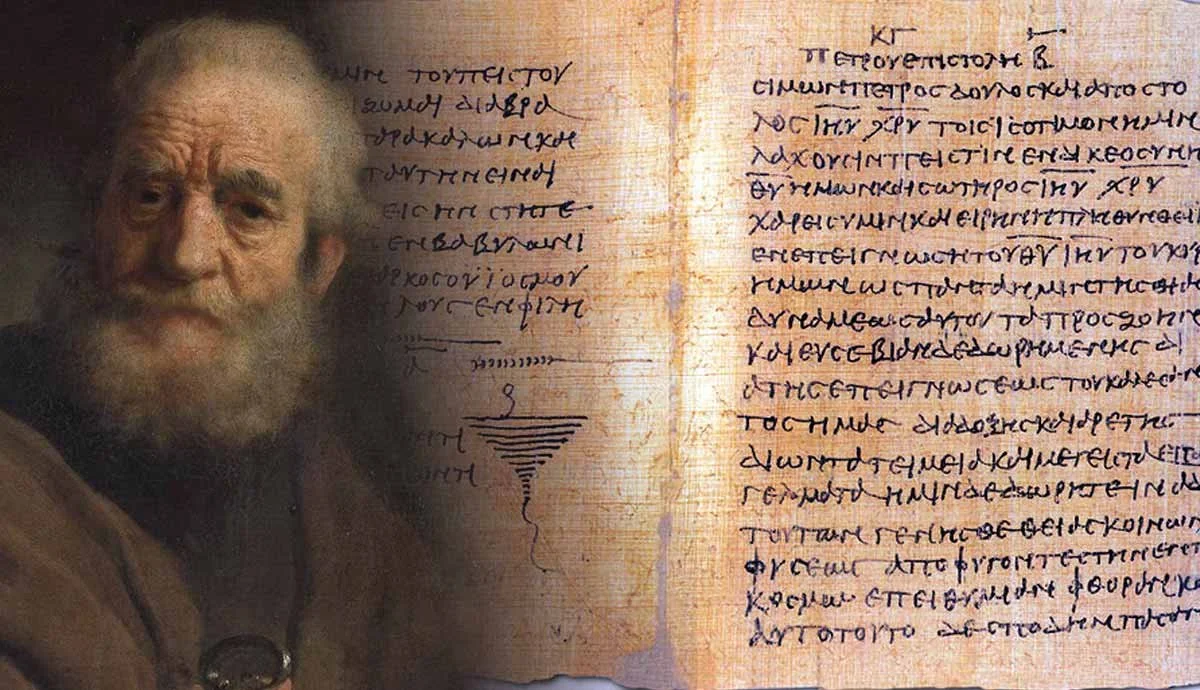
“And after you have suffered a little while, the God of all grace, who has called you to his eternal glory in Christ, will himself restore, confirm, strengthen, and establish you. To him be the dominion forever and ever. Amen. By Silvanus, a faithful brother as I regard him, I have written briefly to you, exhorting and declaring that this is the true grace of God. Stand firm in it. She who is at Babylon, who is likewise chosen, sends you greetings, and so does Mark, my son. Greet one another with the kiss of love. Peace to all of you who are in Christ.”
1 Peter 5:10-14
We come to the end of our study of Peter’s first epistle. At the outset, one of the main concepts we had to wrestle with is the Apostle’s language of the church “in exile,” or as pilgrims or sojourners in this world. By process of elimination, we concluded that this cannot mean the exile of punishment—“There is therefore now no condemnation for those who are in Christ Jesus” (Rom. 8:1). But we saw that this is also not a Gnostic, exile of escapism, where we are just passing through as one’s who have no care for the lives of others, since even of those in Hebrews 11 “hall of faith” looked forward to that eternal city as those
who through faith conquered kingdoms, enforced justice, obtained promises, stopped the mouths of lions, quenched the power of fire, escaped the edge of the sword, were made strong out of weakness, became mighty in war, put foreign armies to flight (Heb. 11:33-34)
Peter ends this letter stating the obvious, that ‘I have written briefly to you, exhorting and declaring’ (v. 12b). Our task in studying such a letter is to take what is brief and bring it into wider context with the whole counsel of God’s word.
Doctrine. The church may be exiled at Babylon for a moment, but stands firm eternally in the God of all grace.
(i.) The church exiled suffers moment by moment.
(ii.) The church eternal is established by grace.
The very structure of this message forms an obstacle for us. Our tendency is to see this is a segmented story, divided into what Francis Schaefer called an “upper story” and “lower story.”1 If not a division between a lower, mundane material life and an upper, spiritual reality, this segmenting will at least divide between the suffering of this present life with the glory of that future state. That is proper in its place, but the utter segregation between our eternal life and this present age is improper. The picture that this Apostle has painted has been that of a permeating City of God and a surrounded earthly city—the whole world occupied, in a sense, simultaneously by two rival forces.
The church exiled suffers moment by moment.
This exile has a condition, a location, and a vocation. Its condition is still suffering, its location is called Babylon, and its vocation is called standing firm.
First, to the condition of this exile. Peter one more time places the drop of time into the ocean of eternity: ‘And after you have suffered a little while’ (v. 10a). A little while here is that drop in the ocean, so that the lone drop that we call time itself dissolves and is no longer even itself. It is called a “light momentary affliction” (2 Cor. 4:17), and “the sufferings of this present time are not worth comparing with the glory that is to be revealed to us” (Rom. 8:18). Peter says much about it in this letter, so I will not belabor the point here. What matters about it is the comparative words: a little while, a little drop in the sea of eternity.
Then I saw a new heaven and a new earth, for the first heaven and the first earth had passed away, and the sea was no more (Rev. 21:1).
So will be the Christian’s suffering.
Second, to the location of this exile. Peter signs off in a cryptic fashion: ‘She who is at Babylon, who is likewise chosen, sends you greetings’ (v. 13a).2 Evidently, the same ‘Mark’ (v. 13c), who authored the second Gospel from Peter’s perspective, and this man ‘Silvanus’ (v. 12a), accompanied Peter while he was in his final earthly destination of Rome, awaiting execution. Which one played more the role of Peter’s secretary here we are not told. But more to the point of location: BABYLON had become a euphemism of the power of Rome, just as much as the power that had turned to darkness over the city of Jerusalem. Modern Christians especially will turn this location into obscure questions of eschatology. Does Babylon in Revelation refer to Jerusalem or Rome? Wrong. It’s both and more, because both of those literal and historical points on the map are just that: they are temporal manifestations, or outposts, of a fundamentally cosmic regime that is always by its very nature on the move.
Earlier in the book of Revelation, the Bible’s regular practice of alternating archetypal names for the wicked city, is used as,
when they have finished their testimony, the beast that rises from the bottomless pit will make war on them and conquer them and kill them, and their dead bodies will lie in the street of the great city that symbolically is called Sodom and Egypt, where their Lord was crucified (Rev. 11:7-8)
As early as the 40s in the first century, Paul had followed Jesus’s lead in those parables in Matthew that start to conceive of the earthly Jerusalem as being turned over by God to the seat of evil power. Thus, “Now Hagar is Mount Sinai in Arabia; she corresponds to the present Jerusalem, for she is in slavery with her children” (Gal. 4:25). But what we see, by the time we get to the end of the Bible, is that final Babylon is a dark spiritual order bent on global domination, to take what belongs to Christ and to murder all of his Christians, at least in body if the devil cannot touch their souls.
Third, there is a vocation in this exile. God calls us to something here. ‘Stand firm in it’ (v. 13c). In what? Where? In Babylon? No. The church is “at” Babylon, but she is not utterly in it. As Jesus taught in various places, that we are in the world and not of it (cf. John 17:14-16; 15:19; 18:36). The object that we are standing firm in is the grace of God. Yes, that is done in the midst of Babylon, but it is done in spite of Babylon. Therefore, it is best seen as we glance upward to our second point.
The church eternal is established by grace.
The first and final and formal causes of grace are right here: ‘the God of all grace, who has called you to his eternal glory in Christ’ (v. 10bc). Really, in one sense, that makes grace the efficient and end causes. Grace is what gave us life to begin with, and grace is the ground under our feet, and, as all future glory is a future grace: Sibbes wrote, “Grace conquers us first, and we, by it, conquer all else; whether corruptions within us, or temptations from outside us.”3
At Babylon we suffer, but this is not the same as saying “We lose down here.” No! What will God do, not only in the end but throughout our exile now? He ‘will himself restore, confirm, strengthen, and establish you’ (v. 10d). These are words that speak of us being refreshed and reinvigorated for the present march home. God’s grace strengthens us now: “for it is good for the heart to be strengthened by grace” (Heb. 13:9), and elsewhere,
the grace of God … [is] training us to renounce ungodliness and worldly passions, and to live self-controlled, upright, and godly lives in the present age (Titus 2:11-12).
Our surroundings are “at Babylon,” but our surroundings are passing away. Recall that passage from Galatians 4, where Paul saw earthly Jerusalem as having been transformed from Sarah to Hagar. The very next words provide the key contrast: “But the Jerusalem above is free, and she is our mother” (Gal. 4:26).
The most real part of us has been repositioned in the lasting city. We have been standing in the City of God—the “Jerusalem above” in not yet consummated as the New Jerusalem of Revelation 21, true. But there is a lasting city permeating the passing city. The two are not two separated bubbles with space in between. The lasting city bears the character of God Himself—transcendent (i.e., above and beyond) and immanent (i.e. near)—so that it is infinitely larger and includes the passing world in it, and manifests itself through wherever He moves the church.
This gives us the right view of our action item. Peter’s words here:
I have written briefly to you, exhorting and declaring that this is the true grace of God. Stand firm in it (v. 12b).
Briefly. I would bet that the original audience, when hearing this read in their assembly, wished he would have said even more. Too brief! they might think. But in God’s wisdom, it is utterly sufficient for its aim. That is just like grace. “My grace is sufficient for you” (2 Cor. 12:9). Apart from God’s grace, not only could we not have been brought to life in this lasting city, but we could not last in this passing city. We could have no real and lasting effect. We tend to separate grace and law; grace and holiness; grace and discipline. The Scriptures do not.
Many professing Christians so long for a Jesus meek and mild that they have no place for a Christ and His kingdom; while others so grasp for a kingdom where justice would reign, that they have no room for grace extended. But Jesus came “full of grace and truth” (Jn. 1:14). One wants grace to breathe. Another wants a place to stand. But Peter says to both: Stand firm on grace. It is a grace in Christ that, that we, “being delivered from the hand of our enemies, might serve him without fear, in holiness and righteousness before him all our days” (Luke 1:74-75).
Practical Use of the Doctrine
Use 1. Instruction. The perennial importance of Peter’s use of the word Babylon is that spiritual Babylon advances parallel spiritual Jerusalem’s advance for two thousand years. But it is only toward the end, as the devil is loose from his chains, that all the pieces come together for globalist Babylon, and the devil is permitted to deceive the nations again as a whole (Rev. 20:3). It is a global Babylon—just as was foreshadowed in the Tower of Babel in Genesis 11—replacing national boundaries with a single pursuit of the wealth of the elite that does the bidding of the beast.
“Alas, alas, for the great city that was clothed in fine linen, in purple and scarlet, adorned with gold, with jewels, and with pearls! For in a single hour all this wealth has been laid waste” (18:16-17)
Note how the plurality of “kings” of he earth become nothing but titular heads within the same system: “And the kings of the earth, who committed sexual immorality and lived in luxury with her” (Rev. 18:9). Clearly, she who is at Babylon must not stand with her.
Use 2. Exhortation. The action item we saw in the text already: Stand firm in grace, even while Babylon presses in all around the church. To stand firm in grace may be counter-cultural, but it is not counter-creational. Grace does not destroy nature, but perfects it. Christ makes His Christians better stewards of God’s design, not worse. So to stand firm in grace is also to stand firm in defense of nature as God has intended it. You must know this, because if you stand firm, you will be branded as anti-social, un-winsome, toxic, or even seditious.
To be perfectly honest, it will take an immediate act of God to have the generations from the twentieth century—the boomers and many of the Gen Xers—to grasp this because of the wider effects of consumerism and the effects in the church of pietism. I can say that “Grace is not an escape from nature” all day long, and the categories are simply not there, and cannot get there except by a season of focused study in the right Sunday school classes and the right books.
Nevertheless, the call is clear. In order to defend the created nature of things, the church at Babylon must not identify with her.
Come out of her, my people, lest you take part in her sins, lest you share in her plagues (Rev. 18:4).
The corporate life of the church is to be a constant separation from that sinking, spiritual Babylon. We can be “at” it without being dependent on it. This is not a call to monasticism in ecclesial life, nor sedition in civil life. It is a call to live the total life of nature in the Garden on the basis of the grace of Christ. Doing that will itself be called “violence” and will draw the actual violence of Babylonian forces. Do it anyway.
Use 3. Correction. If we are established by grace and stand firm by grace, and our God is characterized here as the “God of all grace,” then it is folly to attempt to oppose Babylon by a people characterized by pride, by our own sense of superiority. That’s all been done before. I can tell you from experience that attempts to be counter-cultural by looking for the pure will lead to what the kids call “purity-spiraling.” Nothing will so kill a conservative church than suburban Donatism, whatever may be the flavor of its purity.
If you are unfamiliar with this concept of the purity spiral, just imagine the guillotine in the middle of the town square during the French Revolution, except, instead of lopping the heads off of anyone not radical enough, young men drunk on zeal without knowledge lop the heads off of anyone not spotless enough, not put together enough, not self-made enough, not in enough control. But a graceless fighting force is a headless one, and very soon you have no forces left. If one must have already arrived, one will never move forward.
You want to maximize your army against Babylon’s forces? Stand on grace. From that position which is not ours to boast in, watch Jesus transform broken sheep into zealous shepherds. But you will never see that if you must always confuse the starting line with the finish line. Be established on grace.
__________________________________________________
1. Francis Schaeffer, Escape from Reason (Downers Grove, IL: InterVarsity Press, 1968), 20, 42, 60.
2. Stibbs and Walls note of an older translation: “In the phrase the church that is at Babylon the noun for ‘church’ does not occur in the Greek, but only the feminine definite article with a noun understood.” — 1 Peter, 176.
3. Richard Sibbes, The Bruised Reed (Edinburgh: Banner of Truth, 2005), 97.