
Reading Athanasius, On the Incarnation
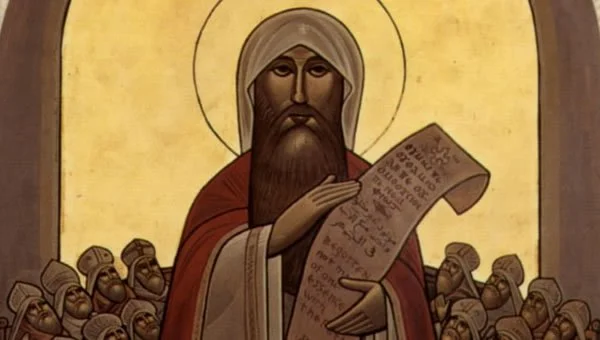
The name Athanasius is symbolic of the victory over Arianism in the generation of the Council of Nicaea. Arius of Alexandria taught that the Son of God was not in fact of the same essence, or substance, as the Father. He expressed it in a concise maxim: “There was when he was not.” That is to say, Arianism placed the Son in the category of the creatures.
It may come as a surprise to discover that in 325, when Constantine convened the Council of Nicaea to settle the matter, Athanasius was only a deacon in the church of Alexandria. It was only when his bishop, Alexander of Alexandria, died a year later that Athanasius became the overwhelming choice. That call was not only to fill Alexander’s office, but also to take the mantle of the orthodox against the Arian heresy.
His tombstone read, “Athanasius Contra Mundum,” which means: “Athanasius Against the World.” He would be exiled five times by four emperors, three of whom professed to be Christians. Clearly, he was seen as a danger not merely for his Christian faith, against the attempted pagan revival of Julian the Apostate, but also for his orthodoxy against a certain Arian bias that made its way even into the courts of Constantinople.
His most enduring book, On the Incarnation of the Word, was not specifically designed to address this error. He wrote it some six or seven years before that famous Council, before Arianism became rampant.
Why has this little work, On the Incarnation, been so widely read and held in such high esteem for so many centuries? In his introduction written to a 1944 edition, C. S. Lewis called the work “a masterpiece,”1 and hinted that seeds of his own more developed view in Miracles first germinated in his mind here.
Rather than retrace the experience of others, I would like to suggest three ways in which this classic work can enrich our Christian faith today. These have to do with our faith in terms of doctrine, apologetics, and practical application. Afterwards I will offer a few concluding thoughts on reconciling Athanasius with a Reformed emphasis on satisfaction of God’s justice.
A Deeper Heart of the Faith
The best theological writing concisely offers penetrating insight into the basic truths. The early church fathers wrote little treatises of this sort. They addressed those matters that Paul calls “of first importance” (1 Cor. 15:3), namely, the cross and empty tomb. In On the Incarnation, Athanasius explores them in language in which every main Christian tradition ought to agree. The work of Christ was, to Athanasius, utterly supernatural in its first and final causes.
Many Christian theologians have examined the necessity of the incarnation. Why did the Son of God have to become man?Athanasius sets his answer in the context of a “divine dilemma,” which begins in God’s goodness and in the hypothetical prospect of his perfect end falling short. He regards this to be unthinkable:
It was unworthy of the goodness of God, that creatures made by Him should be brought to nothing through the deceit rot upon man by the devil; and it was supremely unfitting that the work of God in mankind should disappear, either through their own negligence or through the deceit of evil spirits.2
He does not stop here. Along with God’s commitment to the good world he had made, God’s just and true word punishes disobedience. He could not “go back upon His word regarding death in order to ensure our continued existence.”3
This raises the question of what exactly Athanasius thought was the most basic divine dilemma. For him, God would indeed be just to punish, but out of sheer grace, “He had come to bear the curse that lay on us.”4 It is fashionable for opponents of the doctrine of penal substitutionary atonement to insist that the idea has its origin in Anselm. What, then, do we make of these words of Athanasius?
But beyond all this, there was a debt owing which must needs be paid; for, as I said before, all men were due to die. Here, then, is the second reason why the Word dwelt among us, namely that having proved His Godhead by His works, He might offer the sacrifice on behalf of all, surrendering His own temple to death in place of all, to settle man’s account with death and free him from the primal transgression.5
An Abiding Defense of the Faith
We seldom consider how important the earliest defenses of the Christian faith are. It may be that we assume that early apologetics was uninformed. Philosophical assaults were limited to the Greek schools, there was no “critical scholarship” to speak of, and the age of science was centuries away. Such presumptions are typical of the modern mind. On the contrary, the kind of objections made by those who were still familiar with the cultural, historical, and geographical material of events just under two centuries prior are supremely instructive. Skeptics in that day and age would be more attuned, not less, to the source material, to the significance of words in those languages, and even to the coherence of things supernatural and natural, as their worldviews did not begin by ruling out the former. We are the strangers to the relevant material.
Athanasius divides his later chapters by an apologetic specifically to the Jews and then one specifically to the Gentiles. He argues first against the Jews by saying, “Their unbelief has its refutation in the Scriptures which even themselves read; for from cover to cover the inspired Book clearly teaches these things both in its entirety and in its actual words.” He then cites Isaiah 7:14, Numbers 24:17, 4-5, Isaiah 8:4, 19:1, Hosea 11:1, as to Christ’s origin and identity; Isaiah 53, Deuteronomy 28:66, Jeremiah 11:19, and Psalm 22:16-18 concerning his death;6 and Isaiah 11:10, 35:3-6, and 45:1-2 concerning the knowledge of Christ going forth to the nations.7 Several other arguments are made from the Hebrew canon with an eye toward the uniqueness of Christ as prophet, priest, and king, though he does not use that exact verbiage. Added weight comes from the Olivet Discourse, in which Jesus prophesied His own judgment against that generation, “a sign and notable proof of the coming of the Word that Jerusalem no longer stands.”8
To the Greeks he must argue that such a notion as the Word taking on flesh is both logically coherent and “fitting,” in the sense of being worthy of the dignity of such a transcendent Being. First, he prefigures Augustine in putting the pagan religion on the defensive: “this is indeed a matter for complete astonishment, for they laugh at that which is no fit subject for mockery, yet fail to see the shame and ridiculousness of their own idols.”9 Then he shows that by the same standard of the indignity of the body pagan divinities would also fall. They are either parts of nature or, in Stoicism, the soul of the world. Thus,
If it were unfitting for Him to have embodied Himself at all, then it would be unfitting for Him to have entered into the universe, and to be giving light and movement by His providence to all things in it, because the universe, as we have seen, is itself a body.10
It is at this point that Athanasius expresses concepts things that have led some to wonder whether or not he had early affinities with Apollinarian doctrine. The error by the name Apollinarianism was simply that the eternal logos alone possessed properties of mind, such that to “take on flesh” meant something more like what we would call “remote control.” The Son’s eternal mind thus controlled the body, whereas there was no human mind. To offer a simple reply, such cannot be decisively shown from this book. In one of the more intriguing passages toward this end, the context suggests that Athanasius is merely addressing the question of whether the Son loses His divinity as a consequence of, or “during,” the Incarnation:
The Word was not hedged in by His body, nor did His presence in the body prevent His being present elsewhere as well. When He moved His body He did not cease also to direct the universe by His Mind and might.11
Even the matter of why Christ’s death was by public shame is a piece of his apologetic: “A secret and unwitnessed death would have left the resurrection without any proof or evidence to support it.”12 Likewise, He could have risen immediately rather than on the third day. “But the all-wise Savior did not do this, lest some should deny that it had really or completely died.”13 From these minute details, Athanasius advances arguments more familiar to our evidential apologetics, such as the many lives transformed from that time and place.14
Most Practical Applications of the Faith
When Athanasius surveys the truth of the resurrection he does not confine things to apologetics, but shows its doctrinal and practical significance: “But now that the Savior has raised His body, death is no longer terrible, but all those who believe in Christ tread it underfoot as nothing, and prefer to die rather than to deny their faith in Christ, knowing full well that when they die they do not perish, but live indeed, and become incorruptible through the resurrection.”15 He speaks of men, women, and even children as no longer afraid of death, as if such were commonly observed in his day.16
This casts away not only the fear of death but of spirits. Christ’s work is set forth here as the end of superstition, not all at once like a reverse magic, but gradually, in one kingdom after another, as the gospel light makes its entrance. There had been many so-called wise men and workers of signs, but “what fruit have they to show for this such as has the cross of Christ?”17 Here defense of the faith and living it out come together. Christian miracles are not mere divine flexes to satisfy the demands of human inquiry. They are signs of the new creation invading to solve those deeper predicaments that all men have.
One of the payoffs of the church fathers’ focus on the resurrection is a more informed longing for the eternal state and even a more cosmic (and perhaps less silly and obscure) attention to spiritual warfare.
If He did not rise, but is still dead, how is it that He routs and persecutes and overthrows the false gods, whom unbelievers think to be alive, and the evil spirits whom they worship? For where Christ is named, idolatry is destroyed and the fraud of evil spirits is exposed; indeed, no such spirit can endure that Name, but takes to flight on sound of it. This is the work of One Who lives, not of one dead; and, more than that, it is the work of God.18
This is in keeping with Scripture. The false gods are called dead, just as works done in the old covenant are described as dead, or one’s own body of sin is to be considered dead.19 Death itself—its ultimate power over those of us in Christ—is dead. This is the big picture of conquest over demonic powers. The Bible only tells us this on a need-to-know basis, but it does talk about it. So did the early church fathers. Too often modern Christians live on the extremes of hyper-spiritualism or anti-spiritualism, or, to channel Lewis one more time, between the magician and the materialist. Athanasius gives the church a foundation in Christ over the dominion of darkness.
Concluding Thoughts to Reformed Readers of Athanasius
We become deeper theologians by reading widely. This is also true about a growing ability to reconcile diverse emphases, so long as there is genuine unity in essentials. On the one hand, we can be honest that Athanasius’s emphasis was not quite the same as the Reformed: more revelatory and restorative than forensic and particularistic. On the other hand, he gave due mention to sin being the obstacle between God and ourselves. He is clear that by Adam’s sin “men came under the power of the corruption proper to their nature and were bereft of the grace which belonged to them as creatures in the Image of God.”20
We are not unaware that the attributed saying, He became like us that we might become like him, is given more strength in the words, “He, indeed, assumed humanity that we might become God.”21 The doctrine of theosis that would become identified more with Eastern theology has roots here. It is not unreasonable to charitably read this as a “partaking,” as Peter said it in 2 Peter 1:4, that is, a reflecting and likeness, such as is consistent with the glorified creature in perfected union with the Lord.
It would be an anachronistic reading to recruit Athanasius to one’s side of the exact relations of this substitutionary debt-payment to additional questions such as the scope of the atonement. When Athanasius spoke of “a sufficient exchange for all,”22 for example, the context is the necessity and suitability of the Word taking on human flesh. Nowhere in his mind was the question: For whom exactly did Christ die? If someone were to barge into his line of thought and ask him such a question, he would likely reply at first: Well, for humanity of course—that is, human-kind, just as I said. One would have to make a finer distinction to set his mind on the question of scope.
To the degree that we fixate on what is not in the author’s mind, we will miss out on what is. We will miss his discussion of how the image was lost, like a defaced portrait, but where the Artist is resolved to restore it by conforming it to that Image which has been at His side from eternity,23 or how he weaves together John 12:32, Galatians 3:13, and Ephesians 2:11-18, so that Christ’s arms outstretched on the cross were “that He might draw His ancient people with the one and the Gentiles with the other, and join both together in Himself.”24
____________________________________________
1. C. S. Lewis, Introduction to Athanasius, On the Incarnation (Crestwood, NY: St Vladimir’s Seminary Press, 2002), 9.
2. Athanasius, On the Incarnation, II.6.
3. Athanasius, On the Incarnation, II.7.
4. Athanasius, On the Incarnation, IV.25.
5. Athanasius, On the Incarnation, IV.20.
6. Athanasius, On the Incarnation, IV.34-35.
7. Athanasius, On the Incarnation, VI.38.
8. Athanasius, On the Incarnation, VI.40.
9. Athanasius, On the Incarnation, VII.41.
10. Athanasius, On the Incarnation, VII.41.
11. Athanasius, On the Incarnation, III.17.
12. Athanasius, On the Incarnation, IV.23.
13. Athanasius, On the Incarnation, V.26.
14. Athanasius, On the Incarnation, V.30.
15. Athanasius, On the Incarnation, V.27.
16. Athanasius, On the Incarnation, V.27-29.
17. Athanasius, On the Incarnation, VIII.50.
18. Athanasius, On the Incarnation, V.30.
19. cf. Hebrews 6:1; 9:14; Romans 6:11; 8:10.
20. Athanasius, On the Incarnation, II.7.
21. Athanasius, On the Incarnation, VIII.54.
22. Athanasius, On the Incarnation, II.9.
23. Athanasius, On the Incarnation, III.14.
24. Athanasius, On the Incarnation, IV.25.