
The Cave and the Quadrivium: Book VII of Plato’s Republic
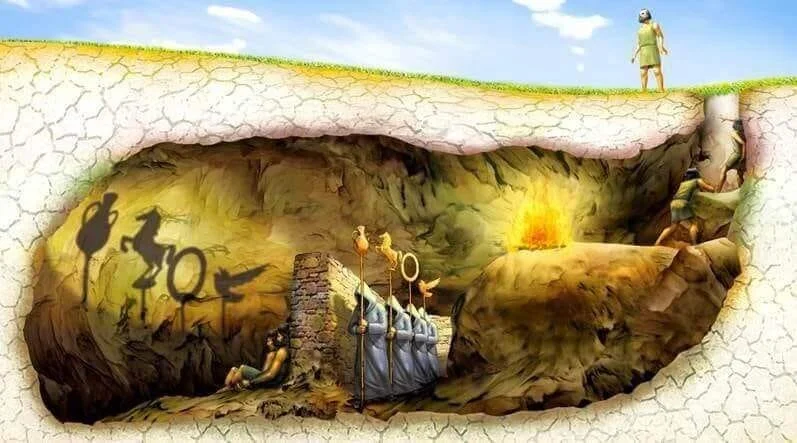
The opening words of the seventh book give us the most famous imagery from The Republic, if not from the whole history of philosophy. It is the allegory of the cave. This is an image of the difference between seeing as a philosopher versus seeing as in a dream, which the great majority do. The latter mistake appearances for true reality. The imagery is even more prophetic of a materialist age such as ours.
Socrates asks those listening to imagine a cave in which a group of prisoners are chained and faced toward the wall. They have been in this state since birth. Behind them is a platform, elevated, upon which is a fire which gives one kind of light. All around the fire, there are men who cast shadows on the wall with puppets or other objects. It is these shadows which the prisoners consider to be the only real objects in existence.
Now much further onward and upward is the opening to the cave and a path toward it, which, if anyone ever traversed, is the outside world with its more radiant light. Lastly, Socrates considers someone who somehow broke free. His sight is compared, both ascending to the ultimate light when his eyes were not yet strong enough, and descending back to the shadows from the lesser light. Each direction would call for an adjustment.
Keys to the Cave
What does each detail in the allegory stand for? Consider first the slaves and their chains. This is the state of everyone short of philosophy. Anyone born into this world is in that state unless or until the light of philosophy illuminates to him the truth, whereas the chains at least represent the settled state that binds them downward to the objects of sense. The shadows stand for the appearances which these prisoners call real, not knowing any better. Neither this nor what goes on just behind them are as conspiratorial as some may think who hear the tale second-hand. Such may indeed be “puppeteers,” and their motions may be those of the elite keeping the masses down after all. However, such is not necessary to read into the meaning, as those men above are in much the same bondage to the merely changeable. The objects one studies in the physical sciences or in history are these shadows—if, or to the degree that, one “studies” them only by noting their surface movements: molecules in perpetual motion, kingdoms in constant strife. That, according to Plato, is precisely what these studies must descend to apart from a philosophical mind.
Socrates also intimates that the “light of the fire in it [is] the power of the sun,”1 and this becomes the key that it is not an “artificial fire” lit that would not already be lit. Perhaps the polytheist might want to imagine them as the gods who are responsible, in some myths, for the actual sun. At any rate, this lower region of the cave’s inside is the sensible world in a perfectly natural sense. The more radiant light above and beyond is that Good of the intelligible world. It is no use trying to decipher the cave without recalling the Divided Line, or the placement of the Good as “the sun” of that intelligible realm. Without that assumption firmly fixed, one approaches the allegory out of context, and hears that the ultimate light source outside of the cave is described by Socrates as “the sun,” and some translations follow that with the pronoun “he,” as the one that the now free man will credit as “the cause of all these things that they had seen.”2
Yes, that literal sun in the story is the Good which the literal sun in our reality mimics, but the reader must be careful to note that our literal sun, in the imagery itself, is the fire inside the cave. That may seem like not too much to follow, but then it is when one thinks about it. The bottom line is that Socrates is applying the two pieces of imagery in Book VI (the Good and the Divided Line) to these two tiers of the cave. One should revisit that material if they get lost.
As to the individual who is free and who would lead the others out, this is the philosopher. One might say that he is the educator. Proponents of the classical liberal arts have rightly pointed here. They will remind you that the word education comes from the Latin word “to lead” (ducere), as in “to lead out.” That is quite true. Yet for Plato, only the philosopher could achieve the synthesis of the educational curriculum. We will return to this. What matters at first is that the only way this new philosopher can lead himself and others out is by the process of dialectic. This is not without great difficulty. The first problem is in himself.
And if he were compelled to look at the light itself, would that not pain his eyes, and would he not turn away and flee to those things which he is able to discern and regard them as in very deed more clear and exact than the objects pointed out? … Then there would need to be habituation, I take it, to enable him to see the things higher up.3
Things would be even worse in trying to persuade the prisoners that everything they presently call “real” is actually the changeable reflection of what is real. The analogy and the difficulties of ascent being discussed, the question turns to how to lead the best natures into that light from youth.4 Such “alumni” will be told that it is their duty to descend and to lead the souls of all into knowledge and virtue, and Socrates agrees that they will share this sense of duty.5
So our city will be governed by us and you with waking minds, and not, as most cities now which are inhabited and ruled darkly as in a dream by men who fight one another for shadows and wrangle for office as if that were a great good, when the truth is that the city in which those who are to rule are least eager to hold office must needs be best administered and most free from dissension, and the state that gets the contrary type of ruler will be the opposite of this.6
This is a central dilemma to the new believer and to the young Christian man who fancies himself an accomplished learner too soon. There is the dilemma of living in the clouds of a private discipleship versus being serviceable to the body at large. But there is also the dilemma of not wanting to be held back, yet seeing that God gives us strengths, even strengths of intellect, in order to serve others.
Quadrivium and Dialectic
They return to the scheme of education itself, its curriculum, which terminates on what became the quadrivium: music, geometry, arithmetic, and astronomy. The word quadrivium means “road of four” or a “fourfold way.” Crucially, everything visible or tangible about these four do not comprise the knowledge they give. Rather, these “can be apprehended only by reason and thought.” The reason that music belongs here had already been well established.
Arithmetic—in other words, “number and calculation”—must be added. This is first because it is “something that applies to all alike.”7 A second reason is because this “really does tend to draw the mind to essence and reality.”8 Thirdly, “natural reckoners are by nature quick in virtually all their studies," and one can be improved in the whole of their thought by this study.9 In general, it has a double use. For the man of the lower arts, as well as for soldiers, quantity is required to calculate and tabulate the units of that with which he works. But for the philosopher, it contemplates being. Since this guardian is both warrior and statesman, he must be such a philosopher, who is able to use arithmetic in its theoretical and practical (or applied) functions. Most specifically, “it strongly directs the soul upward and compels it to discourse about pure numbers, never acquiescing if anyone proffers to it in the discussion numbers attached to visible and tangible bodies."10
Like the general assortment of philosophers, Socrates will take issue with the common lot of geometers: “Their language is most ludicrous, though they cannot help it, for they speak as if they were doing something and as if all their words were directed toward action. For all their talk is of squaring and applying and adding and the like, whereas in fact the real object of the entire study is pure knowledge.”11
What is the chief quality of true geometric knowledge? “That it is a knowledge of that which always us, and not of a something which at some time comes into being and passes away.” Moreover, “it would tend to draw the soul to truth, and would be productive of a philosophical attitude of mind, directing upward the faculties that now wrongly are turned earthward.”12
The others make two mistakes about astronomy naturally coming after geometry. It is first assumed that since geometry studies the surface of the plane, that the solid bodies and their movements would be the next step. Once Socrates stopped them there, it was added that, at least, “this study compels the soul to look upward and leads it away from things here to those higher things.” Not so fast, again Socrates halts them: “I think that it turns the soul’s gaze very much downward.” A crucial distinction is made, as he compared the physical dimension of the study to someone lying on their back staring at a decorated ceiling.
For I, for my part, am unable to suppose that any other study turns the soul’s gaze upward than that which deals with being and the invisible. But if anyone tries to learn about the things of sense, whether gaping up or blinking down, I would never say that he really learns—for nothing of the kind admits of true knowledge.13
Likewise with music, Socrates says,
Or do you not know that they repeat the same procedure in the case of harmonies? They transfer it to hearing and measure audible concords and sounds against one another, expending much useless labor just as the astronomers do … for the numbers they seek are those found in these heard concords, but they do not ascend to generalized problems and the consideration which numbers are inherently concordant and which not and why in each case.14
At the tail end of setting forth the quadrivium, Socrates offers a distinction between philosophy and the lower disciplines, including those in the quadrivium to the degree that they are not driven by dialectic: “This … no one will maintain in dispute against us, that there is any other way of inquiry that attempts systematically and in all cases to determine what each thing really is. But all the other arts have for their object the opinions and desires of men or are wholly concerned with generation and composition or with the service and tendance of the things that grow and are put together.”15
Of putting all of this together, the other academic disciplines have no competency. This will be crucially important to understand in seeing how the university was very much a Christian invention. It was also a classical invention, but there was something missing in the pagan conception of it. He makes this love of wisdom and it method of dialectic the highest of all sciences. Augustine, Thomas Aquinas, and others, would have something to say about that.
Nonetheless, “Then, said I, is not dialectic the only process of inquiry that advances in this manner, doing away with hypotheses, up to the first principle itself in order to find confirmation there.” Indeed, at just that point that the mind, through the other arts, tends downward toward the merely material and practical, “dialectic gently draws it forth and leads it up, employing as helpers and co-operators in this conversion the studies and sciences which we enumerated, which we called sciences often from habit.”16 In short, there is no quadrivium without dialectic. It is what makes the four a single “way” of four.
This also rounds out the picture of the divided line. This “conversion” of the arts, by dialectic, points them all truly upward so that the mind who is trained by them terminates on real objects of knowledge. He says, “Are you satisfied, then … to call the first division science, the second understanding, the third belief, and the fourth conjecture or picture thought—and the last two collectively opinion, and the first two intellection, opinion dealing with generation, and intellection with essence.”17
Closing Observations on the Kind of Men to Be Philosophers
Socrates closes the book by returning to a familiar discussion. He hits upon a plague on our times, but evidently something which has always at least hampered intellectual excellence. We do not make much of intellectual virtues—in other words, conditions and postures of the soul, so to speak, which are either more or less conducive to the reception of truth in one’s own soul, and to its communication to others.
Likewise in respect of truth … shall we regard as maimed in precisely the same way the soul that hates the voluntary lie and is troubled by it in its own self and greatly angered by it in others, but cheerfully accepts the involuntary falsehood and is not distressed when convicted of lack of knowledge, but wallows in the mud of ignorance as insensitively as a pig.18
We are suspicious of intellectual excellence, and we judge it judgmental that error should be condemned. “There are no stupid questions,” we are assured. We are shocked to find Jesus reprove the disciples for having hardened hearts merely because they were clueless as to His meaning about the imagery of the leaven when they got in that boat. We would be scandalized if we knew that Jude in his letter referenced those who are “like animals, unreasoning.” We will accept the excellence of athletic prowess, entrepreneurial genius, and even the beauty of entertainers. Why then do we scoff at excellence of the intellect? For one reason—We know that truth matters, and that we have not done our duty toward it.
But there is the opposite error of pride that even a pagan can spot.
He circles back to the dilemma of the young man: really a dilemma inside of another dilemma. The old and the young both have their characteristic stumbling blocks to truth and its most fruitful civic use. It recalls the saying of Mark Twain, that the great shame about youth is that it is wasted on the young. At any rate, Socrates asks them,
For I fancy you have not failed to observe that lads, when they first get a taste of disputation, misuse it as a form of sport, always employing it contentiously, and, imitating confuters, they themselves confute others. They delight like puppies in pulling about and tearing with words all who approach them.19
Yes indeed, Socrates, we have noticed. And there are gaping holes around us where healthy churches, crucial institutions, and thriving Christian communities would be, if our best and brightest were not also our most smug and divisive, spending their twenties crashing out over some half-baked encounter with a few books and a few disappointing conversations with others who were not quite “up to speed.” But, yes, Socrates, we have painfully noticed.
Thus, after contemplating the self-assured readiness that breeds contention among the young minds, and the prudence that sits back and surrenders the masculine mandate among the aged, Socrates proposes the following: “Fifteen years, said I, and at the age of fifty those who have survived the tests and approved themselves altogether the best in every task and form of knowledge must be brought at last to the goal.” Now they may devote “the greater part of their time to the study of philosophy, but when the turn comes for each, toiling in the service of the state and holding office for the city’s sake, regarding the task not as a fine thing but a necessity.”20 Perhaps we will agree with much of the diagnosis and some of the program, but the heart of the cure itself remains a dream.
______________________________________________________
1. Republic, VII:517b
2. Republic, VII:516b-c
3. Republic, VII:515e, 516a
4. Republic, VII:519a-e
5. Republic, VII:520d-e
6. Republic, VII:520c-d
7. Republic, VII:522c
8. Republic, VII:523a
9. Republic, VII::526b
10. Republic, VII:525d
11. Republic, VII:527a
12. Republic, VII:527b
13. Republic, VII:529b
14. Republic, VII:531a, c
15. Republic, VII:533b
16. Republic, VII:533c-d
17. Republic, VII:533e
18. Republic, VII:535e
19. Republic, VII:539b
20. Republic, VII:540a, b