
A New Covenant
Although the Old Testament has much to tell us about a new covenant, the expression itself is only found in Jeremiah 31. This comes in the midst of a section (Chapters 30-33) called “The Book of Consolation,” so named because of the promised future restoration.
Behold, the days are coming, declares the LORD, when I will make a new covenant with the house of Israel and the house of Judah, not like the covenant that I made with their fathers on the day when I took them by the hand to bring them out of the land of Egypt, my covenant that they broke, though I was their husband, declares the LORD. For this is the covenant that I will make with the house of Israel after those days, declares the LORD: I will put my law within them, and I will write it on their hearts. And I will be their God, and they shall be my people. And no longer shall each one teach his neighbor and each his brother, saying, ‘Know the LORD,’ for they shall all know me, from the least of them to the greatest, declares the LORD. For I will forgive their iniquity, and I will remember their sin no more (31:31-34).
There is a fundamental difficulty for the dispensationalist perspective here. On the one hand, as Paul says about the promises of old, “the gifts and the calling of God are irrevocable” (Rom. 11:29). One of the principal characteristics of the covenant of promise to Abraham was that it will be “everlasting” (Gen. 17:7). Yet it is also crucial to the dispensationalist that the outstanding promises still awaiting fulfillment for Israel are the ultimate subject of this new covenant. The difficulty in need of explanation, then, is the need for a new covenant. All parties have to answer this question. The dispensationalist inserts here the “times of the Gentiles” (Luke 21:24) or the “fullness of the Gentiles” (Rom. 11:25). This does not quite answer how the New Testament uses of “new covenant” would apply to its Christian reader.
By contrast, classical Reformed covenant theology has the advantage of appealing to a deeper sense of an offspring. We have already seen how the New Testament interprets the ultimate offspring of Abraham as all those who would have faith in Christ (cf. Gal. 3:6-8, 27-29), and how Paul operates on Israel with a scalpel from the perspective of the eternal decree:
For not all who are descended from Israel belong to Israel, and not all are children of Abraham because they are his offspring, but “Through Isaac shall your offspring be named” (Rom. 9:6-7).
The dispensationalist must confine the sense of “Israel” and “offspring” to the physical lineage under that ancient civic constitution.
Another seeming advantage for the dispensationalist view is that the wider context of the Jeremiah 31 text also seems to speak of a return to the land in a literal and physical way (Jer. 30:3). Though this must be balanced out with the parallel promise that David will be king over them (30:9; cf. Ezk. 34:23-25; Hos. 3:5).
Michael McKelvey points to a Davidic inclusio to that Book of Consolation. An inclusio is a literary device in which a term or concept both introduces a section and closes it out. His name is mentioned “once in 30:9 … and five times in 33:14-26.”1 At the very least, this narrows the continuation of the covenant people to Judah, even though the central prophecy depicts the covenant as being “with the house of Israel and the house of Judah” (31:31).
Robertson called what we normally call the new covenant by the name “covenant of consummation.” This is to preserve the idea of unity in the covenant of grace. We may note that when the author of Hebrews quotes this in two sections of that epistle (8:8-12; 10:16-17), the context is the greater promises of the New, as well as “a more lasting effectiveness.”2
The Initiation of the New Covenant
As the word “day” that looks back to the exodus in Jeremiah 31:32 “is not to be taken properly,”3 as Roberts says, so the exact day that the New Covenant commences is not such a fine point either. It is that Day of the Lord in its first phase—as those prophecies speak in the language of a singular Day about events millennia apart.
Roberts divided the abrogation of the old covenant at the coming of Jesus into two phases: “{1} More incompletely … before Christ’s death … {2} More completely, by way of consummation, at and near upon Christ’s death.”4
A key passage is one that fits well under the second of those points. In the Upper Room, “And likewise the cup after they had eaten, saying, ‘This cup that is poured out for you is the new covenant in my blood’” (Luke 22:20). The phrase “blood of the covenant” would have already been familiar to them—“And Moses took the blood and threw it on the people and said, ‘Behold the blood of the covenant that the LORD has made with you in accordance with all these words’” (Ex. 24:8). This hints at the Gospel narratives of the Lord’s Supper institution as the new covenant ratification ceremony.
Seven events comprised its initiation: 1. Christ’s death itself; 2. The Lord’s Supper showed the realization of the Passover; 3. Christ’s words from the cross, “It is finished” (Jn. 19:30) reference the payment for sin; 4. The veil of the temple being torn from top to bottom; 5. The resurrection and ascension in themselves; 6. The specific fruit of these—namely, the release of all the elect from captivity and giving of gifts to fulfill the Great Commission (Eph. 4:7-12; Mat. 28:19-20); and 7. The power of the Spirit to empower this work for general and specific ministry (Acts 1:8). It is not entirely clear—though not entirely important either—how Roberts differentiates his sixth and seventh point. The function of these marks remains.5
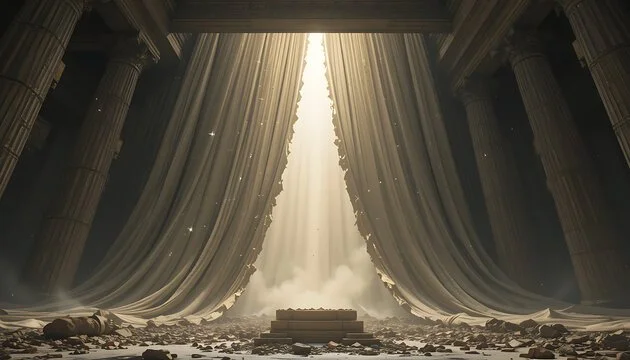
The temple veil torn in two is especially significant. If nothing else, it was a sign of a heavenly accomplishment changing everything on earth. It may be interesting that in Matthew’s account a detail is added about a kind of prefiguring of the resurrection. I will leave to commentators whether this was just that, or whether Matthew is claiming that some of those resurrections occurred in that sequence—that is, prior to Sunday morning and Jesus’s resurrection—but it at least recalls the link between the cross and empty tomb in Jesus’s whole work.
And behold, the curtain of the temple was torn in two, from top to bottom. And the earth shook, and the rocks were split (Mat. 27:51).
In a more dramatic fashion than in any of the other covenant initiations, here, paradoxically, the ground upon which all of the grace in the covenant of grace rests is in heaven. Christ’s work did not merely remove the dividing wall in the earthly temple. It did even that by the more fundamental divide between believing sinners and the presence of God.
Therefore, brothers, since we have confidence to enter the holy places by the blood of Jesus, by the new and living way that he opened for us through the curtain, that is, through his flesh, and since we have a great priest over the house of God, let us draw near with a true heart in full assurance of faith, with our hearts sprinkled clean from an evil conscience and our bodies washed with pure water (Heb. 10:20-22).
This raises questions about what all was new in this new covenant. The author of Hebrews speaks as if “we” all “now” have greater access. How so? Here is where many insist that the Old Testament saints were “in” Abraham’s bosom until this time. Passages like 1 Peter 3:18-20 and Ephesians 4:8-9 are then brought into as puzzle pieces. I do not propose to solve these difficulties here—only to mark out what is most clearly the same between old and new, and what is most clearly to be part of that “greater” in the new. I will borrow from Calvin’s treatment of the subject in Institutes, Book II, Chapters 10 and 11.
Continuity of the New Covenant with the Old
We may take a reminder from Calvin here, “that all whom, from the beginning of the world, God adopted as his peculiar people, were taken into covenant with him on the same conditions, and under the same bond of doctrine, as ourselves.”6 Calvin divided the unity of the covenant that Old Testament Israel was under with the New Covenant under three heads,
—First, That temporal opulence and felicity was not the goal to which the Jews were invited to aspire, but that they were admitted to the hope of immortality, and that assurance of this adoption was given by immediate communications, by the Law and by the Prophets. Secondly, That the covenant by which they were reconciled to the Lord was founded on no merits of their own, but solely on the mercy of God, who called them; and, thirdly, That they both had and knew Christ the Mediator, by whom they were united to God, and made capable of receiving his promises.7
In other words, the end of eternal life, the ground of grace, and the substance of Christ. These three were all the same. The new covenant brings these to fruition, but not into total being.
As to the first, we have seen how the gospel was introduced at least to Abraham (Gal. 3:8), but other texts will speak of how the people under Moses received the same: “the gospel of God, which he promised beforehand through his prophets in the holy Scriptures” (Rom. 1:1-2); “But now the righteousness of God has been manifested apart from the law, although the Law and the Prophets bear witness to it” (Rom. 3:21). We have already seen how the whole of Hebrews 11 makes it impossible to confine the hope of the Old Testament saints to earthly and temporal blessing alone. In the words of praise through Mary and then Zechariah,
He has helped his servant Israel, in remembrance of his mercy, as he spoke to our fathers, to Abraham and to his offspring forever (Luke 1:54-55).
to show the mercy promised to our fathers and to remember his holy covenant (Luke 1:72).
Calvin adds an extended commentary on Paul’s words in 1 Corinthians 10, to show another point of continuity—namely in the sacraments, of which there will also be an obvious element of discontinuity. But he says,
Nay, the Apostle makes the Israelites our equals, not only in the grace of the covenant, but also in the signification of the Sacraments. For employing the example of those punishments, which the Scripture states to have been of old inflicted on the Jews, in order to deter the Corinthians from falling into similar wickedness, he begins with premising that they have no ground to claim for themselves any privilege which can exempt them from the divine vengeance which overtook the Jews, since the Lord not only visited them with the same mercies, but also distinguished his grace among them by the same symbols: as if he had said, If you think you are out of danger, because the Baptism which you received, and the Supper of which you daily partake, have excellent promises, and if, in the meantime, despising the goodness of God, you indulge in licentiousness, know that the Jews, on whom the Lord inflicted his severest judgments, possessed similar symbols. They were baptised in passing through the sea, and in the cloud which protected them from the burning heat of the sun. It is said, that this passage was a carnal baptism, corresponding in some degree to our spiritual baptism. But if so, there would be a want of conclusiveness in the argument of the Apostle, whose object is to prevent Christians from imagining that they excelled the Jews in the matter of baptism. Besides, the cavil cannot apply to what immediately follows—viz. that they did “all eat the same spiritual meat; and did all drink the same spiritual drink: for they drank of that spiritual Rock that followed them: and that Rock was Christ,” (1 Cor. 10:3, 4).8
Calvin wedded together Jesus’s teaching in John 6 about the manna from heaven and Paul’s in 1 Corinthians 10, to say “that the spiritual covenant was common also to the Fathers.”9 There is a great difference between discerning from afar, which is all those Israelites could do, versus failing to discern at all, which is what many did. Calvin’s section here is worth reading, as he chronicles how each of the main Old Testament saints bore witness that this world was not their ultimate home. Of course this is what Hebrews 11 already does, but we are hard of hearing. In summary, he says, “The thing which the Apostle specially urges, and not without reason, is, that they called this world a pilgrimage, as Moses also relates (Gen. 47:9). If they were pilgrims and strangers in the land of Canaan, where is the promise of the Lord which appointed them heirs of it? It is clear, therefore, that the promise of possession which they had received looked farther.”10 He then shows the various Old Testament passages that bear witness to the hope of the resurrection.
Discontinuity of the New Covenant with the Old
The first discontinuity worth speaking about is formal. Even where there is unity there is diversity. Recall the imagery of the flower on its side, stretching from left to right, cover to cover, from root to open petals. Even here where there is one thing, there is an obvious difference in one part versus another. The first is promise and the second is fulfillment. One is clearly not the same as the other in this respect. Paul compares the relationship of the law to the ancient people as a tutor in Galatians 3:24-25 and 4:1-2. Parallel to the promise and fulfillment relationship is the relationship between types or shadows and the substance that they symbolized. Here the same expectation is given to promises, yet there are explicit promises is the form of prophecy and then there is the foreshadowing of the same by means of figures—whether in the form of persons, actions, objects, or events. Hebrews 7 through 10 is the most extensive New Testament treatment of this. Its main focus is on the priesthood, the sacrifices, and the tabernacle. The significant point of discontinuity between shadow and substance comes in this text:
For since the law has but a shadow of the good things to come instead of the true form of these realities, it can never, by the same sacrifices that are continually offered every year, make perfect those who draw near (10:1).
The shadow does not accomplish the ultimate thing required by God, but points to it, reminds, and represents in such a way that faith can look through the window of the type to the true object of faith so typified. So where the object of faith and the means of faith are the same—if I can use a faint analogy myself—the “window material” and the “direction the windows face the object” from differ.
From 2 Corinthians 3, Calvin derives another discontinuity. The former is literal and the latter is spiritual; and in that very form, the former kills and the latter gives life. This is spoken sharply and specifically by Paul and is not meant to encompass every subject that uses those words. For example, Paul did not mean there that the New Testament is not interpreted literally, nor that New Covenant Christians who have the Spirit therefore have no need of either letters or law—two ways that this is sometimes torn out of context by antinomians and experientialists.
Out of the third distinction a fourth arises. In Scripture, the term bondage is applied to the Old Testaments because it begets fear, and the term freedom to the New, because productive of confidence and security. Thus Paul says to the Romans, “Ye have not received the spirit of bondage again to fear; but ye have received the Spirit of adoption whereby we cry, Abba, Father,” (Rom. 8:15). To the same effect is the passage in the Hebrews, “For ye are not come unto the mount that might be touched, and that burned with fire, nor unto blackness, and darkness, and tempest, and the sound of a trumpet, and the voice of words; which voice they that heard entreated that the word should not be spoken to them any more: (for they could not endure that which was commanded, And if so much as a beast touch the mountain, it shall be stoned, or thrust through with a dart: and so terrible was the sight, that Moses said, I exceedingly fear and quake); but ye are come unto mount Sion, and unto the city of the living God, the heavenly Jerusalem,” &c. (Heb. 12:18–22).11
The whole book of Hebrews is an appeal to first century Jews who professed faith in Christ, yet were being lured back into the old covenant as if it could be an addition to the new.
Then, finally, Calvin brings out the difference that Paul speaks of in places like Ephesians 3 as the “mystery of the gospel” which is the inclusion of the Gentiles. This the dispensationalist seizes upon to show that the church was never a consideration in the Old Testament. It was a doctrine unknown to the prophets. This is a non sequitur. We know from texts like 1 Peter 1:10-11 that the sum of what the prophets knew is not logically coextensive with the sum of God’s own meaning. It is quite true that at Pentecost something both new and more powerful was unleashed upon the world from Jerusalem. However, it is not the case that men believed apart from the Spirit before, nor that the old covenant people did not constitute a church with Christ in their midst.
_______________________________________________________
1. Michael G. McKelvey, “The New Covenant as Promised in the Major Prophets,” in Covenant Theology, 193.
2. Robertson, The Christ of the Covenants, 271.
3. Roberts, God’s Covenants, V:18.
4. Roberts, God’s Covenants, III:15, 16.
5. Roberts, God’s Covenants, III:16-17.
6. Calvin, Institutes, II.10.1.
7. Calvin, Institutes, II.10.2.
8. Calvin, Institutes, II.10.5.
9. Calvin, Institutes, II.10.7.
10. Calvin, Institutes, II.10.13.
11. Calvin, Institutes, II.11.9.