
The Universalist Dilemma in Owen’s Death of Death

In his classic work on The Death of Death in the Death of Christ (1684), the Puritan divine John Owen presented what has become known as the Universalist Dilemma. It was aimed not primarily at consistent, full universalists who do not believe that any soul will be lost. Rather it was a problem set before proponents of what is called hypothetical universalism. It is also important to know enough of this historical backdrop in order not to confuse one party with another. Calvinists have often used the expression “hypothetical universalism” as a description of the singular Arminian position on the atonement. While there is a reasonable cause for this application of the label, it will only frustrate the discussion with others to indiscriminately use it.
In our own day, more nuanced historical positions have reemerged in Reformed circles. I am speaking of both the “ordained sufficiency” position that was treated charitably at the Synod of Dort—held most famously by the likes of John Davenant and James Ussher—and the “governmental theory” that was articulated by Hugo Grotius and made a part of Richard Baxter’s system which challenged many among the English Reformed over a wider range of issues. How does Owen’s logic fare in light of these more nuanced positions? Let us begin by examining the form of the dilemma itself, draw forth its premises and certain implications, and then apply it to the objections of these other viewpoints.
The Universalist Dilemma Stated
Toward the end of Chapter III in Book I, Owen wrote,
God imposed his wrath due unto, and Christ underwent the pains of hell for, either all the sins of all men, or all the sins of some men, or some sins of all men. If the last, some sins of all men, then have all men some sins to answer for, and so shall no man be saved … If the second, that is it which we affirm, that Christ in their stead and room suffered for all the sins of all the elect of the world. If the first, why, then, are not all freed from the punishment of all their sins? You will say, “Because of their unbelief; they will not believe.” But this unbelief, is it a sin, or not? If not, why should they be punished for it? If it be, then Christ underwent the punishment due to it, or not. If so, then why must that hinder them more than their other sins for which he died from partaking of the fruit of his death? If he did not, then did he not die for all their sins. Let them choose which part they will.1
It is important to note that the first position is not a strict universalism. It is rather a position not thought all the way through, which is why Owen’s immediate follow-up question about sin functions the way that it does. It is true that the first is framed as “all sin of all men.” However, Owen never attributes to this position the end of all such being saved (i.e., No one will be damned in the end). This universalism is with conscious respect to the work of atonement—e.g., All sins are paid for. The proponent is pressed to make a choice about whether unbelief is one of those sins paid for.
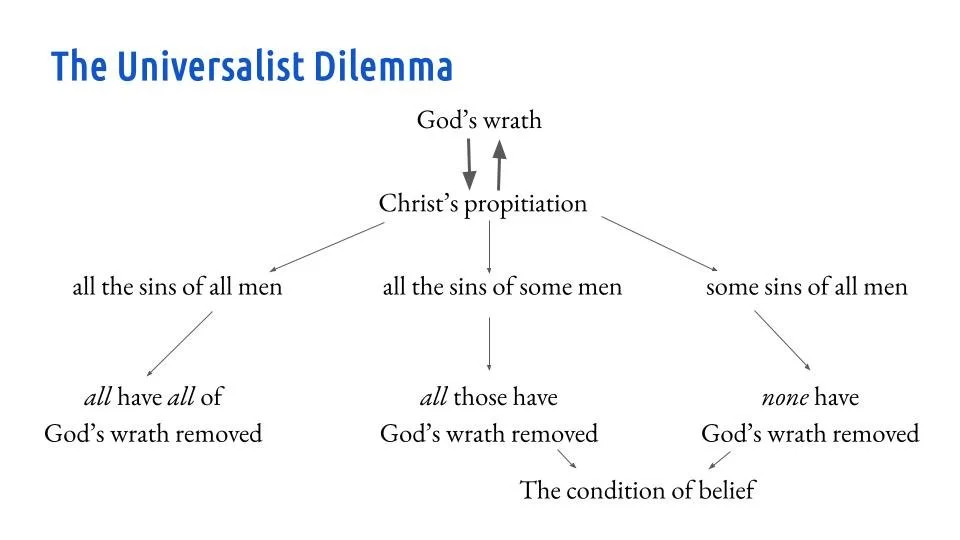
Observe that if such a one answers “Yes” to the first follow-up question (It is a sin), and then “Yes” to the second (Christ did pay for it), then their hypothetical universalism is revealed to be actual or full universalism. If, on the other hand, they answer “Yes” to the first (It is a sin), but then “No” to the second (Christ did not pay for it), then the first position actually empties out into the third. In that case, some sins are not paid for.
One of the many passages Owen cites is Psalm 130:3, “If you, O LORD, should mark iniquities, O Lord, who could stand?” Clearly this references any iniquities—even one. Consequently, this remaining position necessitates that all will be damned. None will be saved. Such a “hypothetical universalism” really turns out to be a definite universal damnation! Now someone who finds himself holding to this third position may counter either: (1) that unbelief ought not be counted as a sin in the same way as other sins; or else (2) that it is certain—and not hypothetical—that many will come to faith, so that while the atonement itself possesses this hypothetical quality, the whole of salvation does not. In order to gather whether or not such maneuvers will evade Owen’s logic, we must consider what sort of assumptions lead up to them and what sort of conclusions might follow.
Antecedents and Consequents of the Dilemma
Owen is clearly assuming something concrete and particular about sin and atonement here. The sin in need of atonement is any and every particular sin. Sin is not dealt with in the abstract, and no one has ever once “sinned in general.” We know from common experience that this is not how injury and forgiveness work. If someone has wronged us, we recognize a true apology as one that honestly deals with the wrong done. We often encounter people who will shift blame precisely by “apologizing” for how it made the offended party feel, or perhaps even some other unhappy results. In these ways, a guilty party can dodge a genuine confession of wrongdoing. In this most important sense, it is no different when it comes to our sin against God. As the Psalmist says,
Against you, you only, have I sinned and done what is evil in your sight (Ps. 51:4).
Atonement is the righting of wrongs. If sin is what is wrong—and sin is always concrete and particular—then atonement is always concrete and particular. All that is wrong is made right; yet since the nature of sin is fundamentally against God who is in need of nothing from the creature, the restitution in view is of the honor of divine justice. If the particularity of sins be admitted, Owen’s logic follows to the end.
Other theological assumptions would include three principles of classical thinking: 1. that God’s decree is eternal and immutable, 2. that no secondary cause is any part of the cause of its first cause, 3. that the external works of the triune God are undivided. How these play out in Owen’s overall argument become apparent as one advances through The Death of Death, but, in layman’s terms, these principles will stop dead in their tracks three attempted resolutions: 1. any attempt to make man’s response to the gospel the efficient cause of distinguishing between elect and reprobate; 2. any attempt to separate either the accomplishment of redemption in Christ’s work from its application by the Spirit’s work, or else; 3. to separate the objects of either (the full number of the elect) from the actions of either (redemption and regeneration) upon them. The same would apply to different phases of the Son’s work, especially, as Owen draws out, Christ’s oblation and intercession. Would one be carried out without respect to the other? Such would be unthinkable concerning the intentions of God.
His intercession for all and every one of those for whom he gave himself for an oblation. He did not suffer for them, and then refuse to intercede for them; he did not do the greater, and omit the less. The price of our redemption is more precious in the eyes of God and his Son than that it should, as it were, be cast away on perishing souls, without any care taken of what becomes of them afterward.2
The furthest reaching consequences Owen had earlier drawn out. If proponents of a general ransom are correct about the end of Christ’s death, then, Owen concludes,
one of these two things will necessarily follow:—that either, first, God and Christ failed of their end proposed, and did not accomplish that which they intended, the death of Christ being not a fitly-proportioned means for the attaining of that end (for any cause of failing cannot be assigned); which to assert seems to us blasphemously injurious to the wisdom, power, and perfection of God, as likewise derogatory to the worth and value of the death of Christ;—or else, that all men, all the posterity of Adam, must be saved, purged, sanctified, and glorified; which surely they will not maintain, at least the Scripture and the woful experience of millions will not allow.3
Not everyone has been persuaded of Owen’s logic.
Four Basic Objections
Four concerns tend to govern those of the hypothetical universalist persuasion. These can be stated in the form of objections.
Objection 1. Belief is the more proper locus of distinction between elect and reprobate in this lifetime.
Objection 2. The offer of the benefits of Christ’s work to all is disingenuous if such have not been procured for all.
Objection 3. There are biblical passages that teach the universal scope of those for whom Jesus died.
Objection 4. There are biblical emphases—and corresponding atonement theories—to which the particular redemption view does not give due weight, or which it even denies.
Since this is not a treatment of the atonement as a whole doctrine, but only an introduction to one part of Owen’s argument, I will answer each of these in terms of Owen’s system.
Reply to Objection 1. Any instance of making God’s primary cause answer to any secondary cause is the ultimate case of putting the cart before the horse. The advocate of hypothetical universalism may deny that he is encroaching upon the divine decree; yet, in insisting that belief is what distinguishes between elect and reprobate, we answer, Yes, that is a basic distinguishing mark. But this is no resolution to the matter we are discussing, since, if election guarantees faith (2 Thess. 2:13) as surely as it guarantees the redemption of those so called (Heb. 9:15), then what becomes of the “problem” that was meant to be solved? The HU advocate’s insistence of the condition of faith is a non-distinguishing solution to a non-existent problem.
Now there is a more sophisticated form of this objection when a devotee to the systems of Grotius, Baxter, Davenant and the like, begin to unite together a particular view of covenant, atonement, and justification. What this amounts to is that covenant and law are thought of more coextensively, so that the work of Christ exists fundamentally within God’s political order. In the first covenant, all died in Adam; in the second covenant, Christ earned righteousness and life for the same—if, that is, the conditions of the covenant were met: the “new law” or “evangelical obedience” of faith.4 Hence the atonement had exclusive respect to this legal foundation. One can say Christ has died for all mankind even while the end of election still makes the benefits of that atonement apply only to the elect. Accomplishment of redemption pertains to all; application of redemption to the elect. Of course even this is a “limited atonement,” in that, while the legal effect of Christ’s work is unlimited, its application through faith is limited.
The one following Owen’s case will insist that this view—however more sophisticated in other respects—does not give due weight to the Scripture’s consistent teaching on the “Godward” dimension of the atoning work. There is an “immediate” consequence of the work of Christ on the believing sinner’s relation to God. It will be said that any “immediacy” is precisely due to the application to a believing heart. However, this is not quite what is meant by immediate. The Scriptures will speak of elements of Christ’s work as the active, causal agent and the sinner’s sins being transferred to Christ for a punishment precisely in that work (2 Cor. 5:21; Gal. 3:13; 1 Pet. 2:24), or the believer’s heart being cleansed by the blood of Christ (1 Jn. 1:7; Heb. 9:14). Yes, there is a “distance” of time and place, not to mention the spiritual reality having to factor in to those divine attributes that are not passive agents in any event. But even all of that misses the point that the cross—or rather, Christ, by means of the cross—directly acts upon the elect in these ways.
Recall that there is not only a unity to the works of the Trinity, as to the persons, but also a unity between means and ends, and between the intention in the end and the results of the same. So, Owen says, “the end of the work and the workman are one and the same,”5 such that, if the acting Agent with this end (the by, through, and for whom [Rom. 11:36] are Father, Son, and Spirit) are perfect in every way and with one will, then, it follows:
God only, whose will and good pleasure is the sole rule of all those works which outwardly are of him, can never deviate in his actions, nor have any end attend or follow his acts not precisely by him intended.6
Thus both views see faith as a condition to secure the benefits. Owen’s scheme accords with God guaranteeing that this condition is met. Indeed the production of faith by regeneration is the first of those benefits (Eph. 2:8-9, Phi. 1:29). Whereas the opposing schemes talk of the condition, yet make it do the work of another, even of Christ.
Reply to Objection 2. We must challenge the premise behind the objection. What exactly makes an offer either genuine or good? We must be careful not to make an invitation of the same allure as the serpent’s original lie. It is not true, as the church leaflet says, that the journey is what matters and not the destination. Any invitation to the Son’s wedding that contains a mirror upon opening is no gospel at all. Therefore we must ask: Is what is good in the gospel offer the ability one has to respond, or is it not what lies within the wedding hall? In all our controversy about a well-meant offer, it would have done us better to question what is meant by well.
Charles Hodge gives us good reason to chase away the shade cast upon the good of this invitation. The Augustinian view—as he uses as a synonym for the Calvinistic view—“teaches that God in effecting the salvation of his own people, did whatever was necessary for the salvation of all men, and therefore to all the offer may be, and in fact is made in the gospel.”7
Hodge then follows with three analogies: one of a man’s family in a ship needing rescue, the second of a man’s family being held captive, and the third making a feast for his friends. The fact that the man in each especially designs to rescue his family and feed his friends does not prevent him from using a boat big enough for everyone stranded at sea, having a sum great enough to secure all who are captive, or cooking enough food or having enough space to accommodate the greatest possible number of guests.
Hodge even asks what may apply to either of the first two scenarios:
Would there be any inconsistency in his offering [the others] to escape? Or, would this offer prove that he had no special love to his own family and no special design to secure their safety?8
Similarly, the feast is “so abundant that he may throw open his doors to all who are willing to come.” What Hodge’s analogies illustrate is that we do not actually have to choose between the all-sufficiency of the work of Christ—if what we mean by “sufficiency” is its intrinsic power to save as many as possible, or its value to God to satisfy justice in answer to the maximum of the injustice of sinners—and the limits set upon its efficiency for the exclusive sake of the elect. To recognize this harmony is not the same as to merely repeat the formula, “Sufficient for all, efficient for the elect.” That would be true if sufficiency was meant as stated just above.
However, what is ordinarily meant by that formula is to restrict the design of redemption to something accomplished for that universal class (sufficient for all). In this way, it is thought, the sovereign grace of God may still flow from election to regeneration and faith and so forth. Thus the HU advocate is still able to affirm that only the elect have this work applied to them. In this way, faith remains a necessary condition.
Those of Owen’s persuasion may then reply that this is much ado about nothing. That faith is a necessary condition marks no difference between the two views. We say the same, at least as far as it goes. Only those who believe will be saved (Acts 4:12, 16:31). Only they will have the benefits of Christ’s work (Jn. 1:12, 1 Pet. 2:7). But that is perfectly consistent with saying that only these same believers have been “elect … unto sprinkling with his blood” (1 Pet. 1:2), or as Jesus put it, “All that the Father gives me will come to me” (Jn. 6:37).
Reply to Objections 3, 4. I think these should be treated together, as the defender of particular redemption is often hampered by his deficiencies in other atonement models when it comes to explaining difficult passages. Here is our operative principle: The doctrine of particular redemption does not exclude other ends of the work of Christ on the cross.
I have always said that every lie is a twisted truth. Along those same lines, it was once said that every heresy is the result of an exaggerated defense of some neglected truth. That is really an application of the same principle. And so it is with rival atonement theories, that they gain the currency that they do because of how true they are.
One theory says that Christ was the bait by which God hooked Satan and defeated him, confounding his expectations of power by weakness. Well, Paul says as much in 1 Corinthians 1:18-25. Another theory says that by the cross, Jesus defeated the works of Satan and his demons. This one is a more modern application and it goes by the name Christus Victor. Colossians 2:15 and 1 John 3:8 would be two texts that would support this. Another says that Jesus’ death on the cross was a moral influence (see 2 Cor. 5:14-15), another that it was an example for us (see 1 Pet. 2:21), and another that it vindicated God’s just governance of the world (see Rom. 3:25). Indeed. That is all true. Now, suppose that we viewed these not as rival theories, but as different aspects of what Jesus accomplished? Would any of these necessarily conflict with the notion that Christ atoned for all the sins of the elect? Not at all. The burden of proof is on the critic to show a real logical tension. How this begins to help us with difficult passages may be imagined, but demonstration of that will have to wait for another time.
___________________________________________________________
1. John Owen, The Death of Death in the Death of Christ, I.3.2 (Edinburgh: Banner of Truth, 2007), 61-62.
2. Owen, The Death of Death, I.3.2 [64].
3. Owen, The Death of Death, I.1.3 [47].
4. Richard Baxter, A Breviate on the Doctrine of Justification, 7-17.
5. Owen, The Death of Death, I.1.3 [50]
6. Owen, The Death of Death, I.1.3 [50].
7. Charles Hodge, Systematic Theology, II.8.2.7 (Peabody, MA: Hendrickson Publishers, 2008), 556.
8. Hodge, Systematic Theology, II.8.2.7 [556].